Monitoring
Shunt Battery Monitor vs Voltmeter: Which Reads State of Charge?
Researched from published standards and manufacturer specifications. Updated .
Quick answer
A shunt monitor reads LiFePO4 state of charge accurately because it counts amp-hours in and out; a voltmeter cannot, because lithium voltage sits nearly flat around 13.1V across roughly 20 to 90 percent of charge. On lead-acid, a rested voltmeter is a genuinely reasonable guide, reading about 12.73V at full and 12.10V at 50 percent.
A voltmeter has one job: report the electrical pressure across two points at the instant you check it. On a lead-acid battery that is a workable proxy for state of charge, because a lead-acid cell's resting voltage falls in a fairly straight line as it discharges. On a LiFePO4 battery, that same voltmeter gives you almost the same number whether the bank is nearly full or getting low, because lithium chemistry holds a nearly flat voltage plateau through most of its usable range. The meter has not failed. The question you are asking it just does not have a voltage-shaped answer on that chemistry.
A shunt monitor sidesteps the whole problem by measuring something else entirely: the actual current flowing past a precision resistor, integrated over time. It adds up every amp-hour that leaves the bank and every amp-hour that comes back, and reports a running percentage that tracks the real state of charge regardless of what the flat part of the discharge curve is doing to the voltage. That is why a shunt is the correct tool for lithium, and why a voltmeter alone is genuinely fine for a lead-acid bank you are willing to rest before reading.
Why does LiFePO4 voltage stay flat while lead-acid voltage does not?
The flatness is a property of the lithium iron phosphate chemistry itself, not a manufacturing defect or a bad cell. Once a LiFePO4 cell leaves its top few percent of charge, the chemical reaction inside settles into a plateau where a large amount of stored energy corresponds to only a small voltage change. A lead-acid cell has no comparable plateau; its voltage declines in a more continuous slope from full to empty, which is exactly what makes a rested voltmeter reading useful on that chemistry and nearly useless on lithium.
This is also why a lithium pack can look fine on a voltmeter right up until it is nearly out of usable capacity, then drop off a cliff. The flat middle of the curve gives no warning. A shunt, tracking amp-hours rather than volts, sees that same bank counting down normally the entire time.
Lead-acid resting voltage against approximate state of charge
On a lead-acid battery, resting voltage after several hours off charge and off load is a genuinely useful guide. These are commonly published reference figures for a 12V lead-acid battery at rest.
| State of charge | Resting voltage | Reading conditions |
|---|---|---|
| 100 percent | 12.73V | Several hours off charge and off load |
| 50 percent | 12.10V | Several hours off charge and off load |
Published standard Source: Commonly published lead-acid resting-voltage reference figures used across the battery industry. These figures only mean anything after the battery has rested. A battery read mid-charge or under load will show a voltage that has nothing to do with its real state of charge, on either chemistry.
Shunt monitor against voltmeter, side by side
| Shunt monitor | Voltmeter only | |
|---|---|---|
| Accurate on LiFePO4 | Yes, tracks amp-hours directly | No, voltage stays flat through most of the range |
| Accurate on rested lead-acid | Yes | Yes, if rested several hours off charge and load |
| Accurate under load or mid-charge | Yes, current is measured continuously | No, on either chemistry |
| Installation | Wired inline on the battery negative, plus a display | None, most systems already show voltage somewhere |
| Typical cost | $42 to $110 for the units compared here | $0, usually already built into an existing display |
| Drifts over time without recalibration | Slowly, needs a periodic full charge to resync to 100 percent | No drift, but no accuracy on lithium either |
Convention Source: Manufacturer specifications for the shunt monitors listed on this page. A shunt needs the bank to reach a true full charge occasionally so its percentage readout can resync. Skipping that reset lets small measurement error accumulate over weeks.
Does a voltmeter ever work for reading a lithium bank?
Only at the two extremes. A LiFePO4 pack sitting well above 90 percent or dropping below roughly 20 percent shows a real, moving voltage, because those are the sloped ends of the curve rather than the flat middle. A voltmeter reading 13.6V after a full charge, or one reading 12.0V and falling, is telling you something real. Anywhere in between, a reading of 13.1V could mean 85 percent or 35 percent, and the meter has no way to tell you which.
That middle range is also where most of a lithium bank's usable capacity actually lives, which is exactly the part a voltmeter cannot see into. A shunt has no such blind spot, since it is counting amp-hours the entire time rather than sampling a voltage that has stopped moving.
What if a lithium battery already has Bluetooth reporting built in?
Some packs, including the Dyness 12V 100Ah LiFePO4 and the HeyFuture 12V 100Ah LiFePO4, report an internal state of charge estimate over Bluetooth without a separate shunt. That internal estimate is still built from the battery's own internal current sensing, which is the same amp-hour counting approach a shunt uses, just built into the battery management system instead of wired externally. If a bank is built from a single such battery, that built-in reporting can stand in for an external shunt. Once a bank grows to two or more batteries wired together, or the reader wants one number for the whole bank rather than one per battery, an external shunt on the combined bank becomes the more reliable single source of truth.
How long does a lead-acid battery actually need to rest before the voltage reading means anything?
Both charging and recent load leave a temporary voltage signature on a lead-acid battery that has nothing to do with its true state of charge. A battery pulled straight off a charger can read well above its real resting voltage for an hour or more while what electricians call surface charge dissipates, and a battery that just powered a heavy load can briefly read lower than its true state until the plates chemically settle back out. A reading taken in either window will overstate or understate the real number, sometimes by more than one state-of-charge band on a reference chart.
A practical rule many RV owners use is to let the battery sit with no charging source connected and no load drawing from it for several hours, ideally overnight, before trusting a voltmeter reading against a resting-voltage chart. That patience requirement is itself a real cost of relying on voltage alone: a shunt monitor gives a usable number the instant you look at it, charging or not, loaded or not, because it is tracking amp-hours continuously rather than waiting for the battery to settle.
Do not judge a lithium bank's remaining runtime from a dash voltmeter alone. A reading in the 13.0V to 13.2V range can represent anywhere from roughly 85 percent down to 25 percent state of charge on many LiFePO4 packs. Wire in a shunt if the bank is lithium and boondocking runtime matters.
Shunt monitors worth wiring in
All four of these are true shunt-based monitors, meaning they measure current directly rather than inferring it from voltage. Pick by voltage range and whether you want a phone app or a dash-mounted display.

Victron SmartShunt 500A Battery Monitor
Price varies, check the listingWide 6.5V to 70V input range and Bluetooth logging, so it works whether the bank stays at 12V or later moves to a higher system voltage.
Best for: Any lithium bank you plan to boondock on.
Check price on Amazon
LiTime 500A Bluetooth Battery Monitor
$109.99An 8V to 120V range on the same shunt, useful if a future rebuild pushes the bank voltage up.
Best for: A build that may change system voltage later.
Check price on Amazon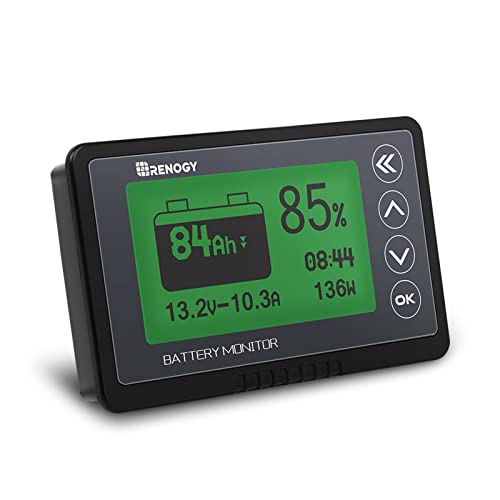
Renogy 500A Battery Monitor with Shunt
$63.10A wired shunt and display at a low price, without the Bluetooth app layer some owners never open anyway.
Best for: A panel-mounted readout.
Check price on Amazon
AILI TR16 Shunt Battery Monitor
$42.00The lowest-cost shunt-based monitor in this lineup, and a cheap shunt still reads lithium correctly where any voltmeter cannot.
Best for: A first real state of charge readout.
Check price on AmazonFrequently asked questions
- Why does my lithium battery show 13.1V whether it is nearly full or half empty?
- That flat reading is normal for LiFePO4 chemistry. Between roughly 20 and 90 percent state of charge, the voltage barely moves, sitting around 13.1V across most of that range. A voltmeter genuinely cannot distinguish those states on this chemistry. A shunt monitor, which counts amp-hours in and out instead of reading voltage, gives you the real number.
- Can I use a voltmeter on my lead-acid battery instead of buying a shunt?
- Yes, and it works reasonably well, with resting voltage figures like 12.73V at full and 12.10V at 50 percent giving a genuine estimate. The catch is the resting requirement: you need several hours off charge and off load before the reading means anything. Checked mid-drive or right after unplugging shore power, the number reflects charging or load state, not true state of charge.
- Do I need a shunt monitor if my lithium battery already has Bluetooth?
- Often not for a single battery, since built-in Bluetooth reporting on packs like the Dyness or HeyFuture already uses internal current sensing rather than voltage alone. Once you wire two or more batteries into one bank, or want a single combined reading instead of one per battery, an external shunt on the whole bank becomes the more reliable source.
- How often does a shunt monitor need to be reset or recalibrated?
- A shunt should see the bank reach a genuine full charge periodically, which lets its internal percentage counter resync to 100 percent and correct any small measurement drift that accumulated. Most owners get this automatically just from normal shore power or solar charging reaching full every so often. A bank that never reaches full can show a slowly drifting, increasingly inaccurate percentage.
- Is a $42 shunt as accurate as a $110 one for reading state of charge?
- For the core job, counting amp-hours in and out, a budget shunt like the AILI TR16 uses the same fundamental measurement approach as a pricier Victron unit. The price difference is mostly Bluetooth polish, app features, and brand support rather than a difference in whether the amp-hour counting itself works.
- Where does a shunt actually get wired into the system?
- A shunt installs inline on the battery bank's main negative cable, between the battery negative terminal and everything else the negative bus feeds. Every amp that leaves or returns to the bank has to pass through the shunt for the reading to be accurate, so it cannot be wired onto a branch circuit or a single load instead of the main negative path.
Wire the shunt on the main negative, not a branch circuit. A shunt reads what passes through it, so anything wired around it, such as a load connected straight to the battery terminal instead of through the shunt-monitored bus, will not be counted and will throw off every percentage the monitor reports.