Batteries
LiFePO4 vs AGM for an RV House Battery: Which One to Buy
Researched from published standards and manufacturer specifications. Updated .
Quick answer
The LiFePO4 versus AGM question is really a question about how you camp and how long you plan to keep the battery. Both chemistries hold a nameplate number that does not tell you what you can actually use, and both have a real cost that shows up after the purchase rather than on the price tag.
This page compares them on the numbers that decide the outcome: usable capacity per rated amp-hour, weight, charge acceptance, cold-weather behavior and cycle life, then names the specific situations where AGM is still the right call.
Is LiFePO4 really worth the extra money over AGM?
For a boondocker, usually yes. For a campground camper who plugs in most nights, often no. The honest way to compare is dollars per usable amp-hour, not dollars per rated amp-hour. A 100Ah AGM at roughly $270 gives about 50Ah usable, near $5.40 per usable amp-hour. A 100Ah LiFePO4 at roughly $160 gives about 80Ah usable, near $2 per usable amp-hour, before counting that it also survives several times more cycles. The AGM is cheaper on the shelf and more expensive per amp-hour you can actually draw.
LiFePO4 vs AGM head to head
Usable depth of discharge figures below are a convention, not a manufacturer specification. Manufacturers publish cycle life against a depth of discharge curve rather than a single usable number, and the values here are the widely used planning assumption for each chemistry.
| Factor | LiFePO4 | AGM |
|---|---|---|
| Usable capacity (100Ah rated) | ~80Ah (80% convention) | ~50Ah (50% convention) |
| Typical weight | ~22 to 26 lb | ~60 to 65 lb |
| Cycle life at typical use | Several thousand cycles | Several hundred cycles |
| Charging below freezing | Needs BMS cutoff or self-heating | No special cutoff needed |
| Charge acceptance rate | Fast, near full amperage until nearly full | Tapers earlier, slower overall |
| Needs its own charge profile at every source | Yes: converter, solar controller, DC-DC charger | No, standard lead-acid profile works |
Convention Source: Usable depth of discharge is an industry planning convention; weight, charge acceptance and cold-charging behavior are drawn from manufacturer datasheets in this catalog.. Cycle counts vary by depth of discharge and manufacturer; treat the ranges as planning figures, not a guarantee for a specific unit.
What LiFePO4 costs you later that the sticker price does not
A lithium bank is not a drop-in replacement in the way it is marketed. It needs a genuine lithium charge profile at every source that touches it: the converter, the solar charge controller and any DC-DC charger from the alternator. A converter or controller running a lead-acid profile will undercharge a lithium bank and never reach full capacity. Check every charging source before you buy the battery, not after.
The other real limitation is cold weather. A LiFePO4 cell must not accept charge current below freezing without a low-temperature BMS cutoff, or with a self-heating pack like the Redodo above. Charging a standard LiFePO4 battery below freezing degrades the cells even when the BMS lets current through on some designs, so check that the specific battery's BMS actually stops charging at low temperature rather than assuming it.
When AGM is genuinely the right call
A weekend camper who plugs into shore power most nights and rarely dry camps past a day or two will not draw down the bank far enough, or often enough, for the lithium cycle-life advantage to pay back the price difference. A rig that already has a lead-acid converter, with no plan to replace it, avoids the charge-profile problem entirely by staying on AGM. And a backup or seasonal-storage battery that sits mostly idle has no cycle count to amortize a lithium premium against.

VMAX SLR100 12V 100Ah AGM Deep Cycle
$269.96A true deep cycle AGM with no cranking rating on the label, which is the fastest way to tell a house battery from a starting battery.
Best for: A lead-acid bank where lithium is out of budget.
Check price on AmazonHow the weight difference actually shows up on the road
A 100Ah AGM battery at roughly 60 to 65 pounds versus a 100Ah LiFePO4 battery at roughly 22 to 26 pounds is not just a lifting convenience, it is payload. A two or three battery lead-acid bank can eat 150 to 200 pounds of a trailer's cargo carrying capacity before a single pot, tool or gallon of water goes in. Owners who are already tight on payload, which is common on smaller travel trailers with modest CCC ratings, often find the weight savings alone worth more than the cycle-life argument, independent of how they camp.
What each battery does for you when something goes wrong
Most LiFePO4 packs in this catalog ship with a built-in battery management system that protects against over-discharge, over-current and, on the models above, over-temperature and low-temperature charging. That BMS will disconnect the battery rather than let it be damaged, which shows up as the battery simply cutting out under a fault rather than failing gradually. A standard AGM battery has no equivalent internal protection: it will accept an over-discharge or a wiring fault without disconnecting itself, and the failure shows up later as reduced capacity or a swollen case rather than an immediate, protective cutoff.
How voltage behavior differs between the two, and why it matters for your monitor
A LiFePO4 battery holds a flat voltage across most of its discharge curve, only dropping sharply near the bottom of its usable range, which means a simple voltage-based meter reads misleadingly close to full right up until the battery is nearly empty. An AGM battery's voltage drops more steadily and predictably as it discharges, so a basic voltmeter gives a rougher but more continuously useful state of charge estimate on lead-acid than it does on lithium. This is the practical reason a shunt-based battery monitor, which tracks amp-hours in and out rather than voltage alone, is treated as close to mandatory on a LiFePO4 bank and optional on an AGM one.
Cold-weather charging is not optional to check. Confirm the specific LiFePO4 battery's BMS includes a low-temperature charge cutoff, or buy a self-heating model, before you charge it in a battery bay that can drop below freezing.
Which battery to buy
Match the battery to how you actually camp, not to the marketing on the box. A weekend camper who plugs into shore power most nights gets little benefit from lithium cycle life. A boondocker running a fridge and a CPAP off the battery for a week between charges gets the usable-capacity gap back within a season or two.
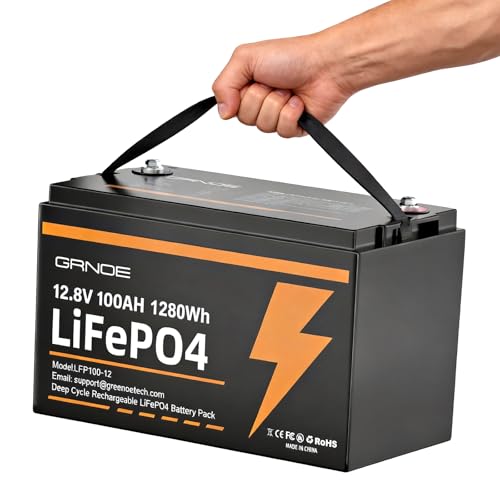
GRNOE 12V 100Ah LiFePO4, Group 31
$159.00Group 31 footprint, 100A BMS, and the lowest price per usable amp-hour in the lithium lineup here.
Best for: Budget-led single battery replacement.
Check price on Amazon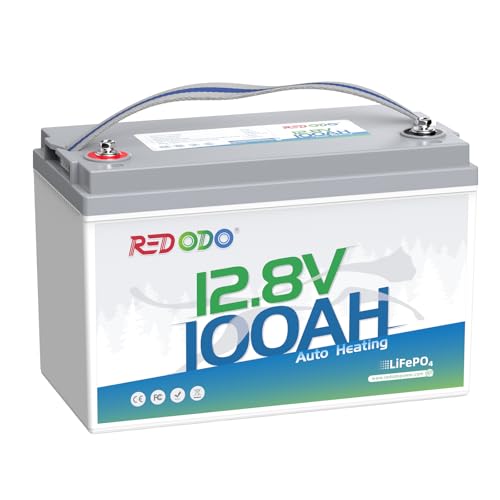
Redodo 12V 100Ah Self-Heating LiFePO4, Group 31
$278.99Self-heating cells pull warmth from the charge source before accepting current, which is the fix for the freezing-temperature charging limit below.
Best for: Cold season camping where the battery bay drops below freezing.
Check price on Amazon VMAX SLR100 12V 100Ah AGM Deep Cycle
$269.96A true deep cycle AGM with no cranking rating on the label, which is the tell that separates a house battery from a starting battery.
Best for: A lead-acid bank where lithium is out of budget.
Check price on Amazon
Renogy 12V 200Ah Deep Cycle AGM
$395.99Doubling AGM capacity to reach a lithium-sized usable bank, for a build where upfront cost outweighs weight and cycle count.
Best for: A large lead-acid bank where weight is not a constraint.
Check price on AmazonFrequently asked questions
- How much usable capacity does a 100Ah AGM battery actually give?
- About 50Ah, using the widely applied 50 percent usable depth of discharge convention for lead-acid batteries. Manufacturers publish cycle life against a discharge depth curve rather than a single usable figure, so this is a planning number, not a spec on the battery. Draining an AGM further shortens its cycle life more than the same draw would shorten a LiFePO4 pack.
- Can I just swap a lithium battery into my existing AGM setup?
- Only if every charging source already applies a lithium profile. A stock converter, an older solar charge controller, and some alternator setups default to a lead-acid profile that will never fully charge a LiFePO4 bank and may not protect it correctly. Check the converter, the solar controller and any DC-DC charger before buying the battery, not after.
- Why is LiFePO4 so much lighter than AGM at the same rated capacity?
- Lithium iron phosphate cells store more energy per pound than the lead plates and acid electrolyte inside an AGM battery. A 100Ah LiFePO4 battery typically weighs 22 to 26 pounds, while a 100Ah AGM battery of the same rated capacity typically weighs 60 to 65 pounds, a difference of roughly three times.
- Does LiFePO4 stop working in cold weather?
- It stops accepting charge below freezing unless the battery has a low-temperature BMS cutoff or self-heating cells, both of which exist specifically to solve this. Discharging a LiFePO4 battery in cold weather is generally fine; charging it without protection at low temperature is the part that damages the cells.
- Is a 200Ah AGM bank a reasonable alternative to 100Ah of LiFePO4?
- It can work if upfront cost matters more than weight or cycle life. A 200Ah AGM bank gives roughly 100Ah usable, similar to a 100Ah LiFePO4 battery, but weighs well over 100 pounds more and holds far fewer total cycles before it needs replacing. It also avoids the lithium charge-profile requirement entirely.
- How many usable amp-hours do I actually need before choosing a chemistry?
- That depends on your daily load and how many days you camp without plugging in, not on the chemistry itself. Size the usable capacity first with a load calculation, then pick the rated battery size and chemistry that delivers it, since a smaller LiFePO4 bank and a larger AGM bank can land at the same usable number.
A word on safety. Never charge a LiFePO4 battery below freezing unless the BMS has a verified low-temperature cutoff or the pack is self-heating. Confirm every charge source, converter, solar controller and DC-DC charger, uses a genuine lithium profile before putting a lithium bank into daily use.