Reviews
Victron SmartShunt 500A Review: What It Measures and Who Needs a Screen Instead
Researched from published standards and manufacturer specifications. Updated .
Quick answer
A battery monitor like the Victron SmartShunt 500A does one job: it counts the amp-hours moving in and out of the battery bank so it can report a real state of charge, rather than inferring one from voltage. That distinction matters most on a lithium bank, where the voltage curve sits close to flat, often reading near 13.1V from roughly 20 percent charged all the way to 90 percent. A voltmeter cannot tell those states apart. A shunt, watching current flow rather than voltage, can.
The SmartShunt is Victron's monitor built with no separate display head, no wired panel meter, just the shunt itself and a Bluetooth connection to a phone running the free VictronConnect app. That single design choice, deciding it does not need its own screen, is the thing every buyer should weigh before ordering it, more than the amperage rating or the accuracy spec.
Does a battery really need a shunt instead of just a voltmeter?
On a lead-acid or AGM battery, not always, since voltage drops fairly steadily as the battery discharges and a decent voltmeter gives a rough but usable read. On a LiFePO4 bank, yes, close to always. LiFePO4 cells hold a nearly flat voltage across most of their usable range, so a battery reading 13.1V could be sitting at 25 percent charged or 85 percent charged, and a voltmeter alone cannot tell you which. A shunt-based monitor like the SmartShunt tracks amp-hours consumed and returned directly, which is the only method that produces a trustworthy percentage on lithium. This is also why the product's specification sheet lists a synchronization voltage and a charged-detection setting rather than relying on voltage alone; those settings periodically reset the counter against a known full-charge point so small measurement drift does not accumulate over weeks of use.
Shunt-based battery monitors compared
The table below compares the SmartShunt against the other shunt-based monitors carried in this catalog, using each manufacturer's published specifications. Full specifications for the SmartShunt itself are on its dedicated page linked below.
| Monitor | Amp rating | Voltage range | Display | Listed price |
|---|---|---|---|---|
| Victron SmartShunt 500A | 500A | 6.5V to 70V | Phone app only, Bluetooth | Not published in this catalog |
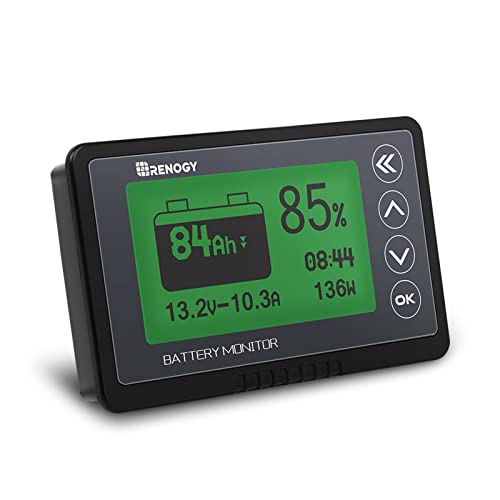
| Renogy 500A Battery Monitor | 500A | Not published | Wired display head included | $63.10 |
| LiTime 500A Bluetooth Monitor | 500A | 8V to 120V | Phone app only, Bluetooth | $109.99 |
| AILI TR16 Shunt Monitor | 500A | 8V to 120V | Wired display head included | $42.00 |
Published standard Source: Manufacturer-published specifications and current catalog listings in this repository.. Victron does not publish a price through the channel this catalog tracks; check the live listing before comparing cost against the other monitors here.
What the SmartShunt does not include
The SmartShunt is a shunt and a Bluetooth radio in one housing, and nothing more. It has no display of its own, so a reading always requires a phone or tablet running VictronConnect within Bluetooth range of the battery bay. It does not include a relay for automatic load disconnect built in; that function exists on separate Victron accessories, not inside the SmartShunt itself. And it does not charge or protect the battery in any way, it only measures it, so it changes nothing about how the bank is charged or how a BMS behaves. Buyers who assume a monitor manages the battery are buying the wrong category of product regardless of brand.
Who should not buy it?
Anyone who wants a number visible at a glance without pulling out a phone, such as at a fixed dash-mounted panel or a shared rig where several people check the battery, should look at a monitor with a wired display head instead, like the Renogy 500A monitor above. Anyone already committed to a different monitoring ecosystem, such as a system built around a different solar controller's own app, may find a second, unconnected app more friction than benefit even though the SmartShunt itself works correctly on its own. And anyone monitoring a lead-acid or AGM bank rather than lithium gets much less benefit from precise amp-hour counting, since a basic voltmeter already reads AGM state of charge reasonably well; the case for spending on any shunt monitor is strongest on lithium.
What owners report about setup and daily use
Owners consistently report that VictronConnect is straightforward to pair on first setup and that the app's live current and voltage readouts update quickly enough to be useful for diagnosing where a parasitic draw is coming from. A recurring theme in verified owner reviews is that getting an accurate state of charge percentage depends on correctly setting the battery capacity and the charged-voltage detection point during initial configuration, and that owners who skip that step see a drifting or inaccurate percentage until they go back and set it properly. Bluetooth range is the other recurring topic: several owners report the connection is reliable from inside the rig but drops if the shunt is mounted inside a metal enclosure or a densely packed battery compartment, a known Bluetooth limitation rather than a defect specific to this unit. Owners who need a more dependable connection from outside the rig report better results after adding Victron's own networking hardware, sold separately.
The honest alternatives
The Renogy 500A monitor is the pick for anyone who wants a wired display and does not need Victron's ecosystem or app polish; it costs a fraction of the SmartShunt's typical street price and reports the same core amp-hour counting. The AILI TR16 is the genuinely cheap option among true shunt monitors, and a cheap shunt still gives a real amp-hour count that beats any voltmeter on a lithium bank; it also includes its own display, so it carries none of the SmartShunt's phone dependency. The LiTime 500A Bluetooth monitor sits between the two, phone-only like the SmartShunt but at a lower price and with a wider input voltage range that covers a future move to 24V or 48V.
Wire the shunt correctly or the reading means nothing. Every negative return from the battery, every load and every charge source, has to route through the shunt's monitored side, with only the single connection to the battery negative terminal on the other side. A load or ground wired around the shunt instead of through it will make every amp-hour reading wrong without any error showing on the app.
Which battery monitor to buy
Buy the SmartShunt for Victron's ecosystem and app polish if a phone-only reading is genuinely fine day to day. Buy the Renogy monitor instead the moment a wired display matters more than that ecosystem, since it reports the same core amp-hour count for far less money.
Renogy 500A Battery Monitor with Shunt
$63.10Includes its own display head, so a reading does not require a phone in hand, at a fraction of the SmartShunt's typical street price.
Best for: A panel-mounted readout.
Check price on Amazon
AILI TR16 Shunt Battery Monitor
$42.00The cheapest true shunt monitor in this catalog, and it includes a display head the SmartShunt does not.
Best for: A first real state of charge readout.
Check price on Amazon
LiTime 500A Bluetooth Battery Monitor
$109.99Covers 8V to 120V, useful if the system voltage might change later, at a lower price than the SmartShunt.
Best for: A build that may change system voltage later.
Check price on AmazonFrequently asked questions
- Does the Victron SmartShunt 500A need internet access to work?
- No. It only needs Bluetooth, which pairs directly with a phone or tablet running the free VictronConnect app within roughly 10 meters, less through metal enclosures. No internet connection or account is required for basic monitoring, though Victron's optional networking devices, sold separately, do use an internet connection for remote monitoring away from the rig.
- Can I add a display to the SmartShunt later?
- Not directly, since the SmartShunt has no wired display port built in. The way to get a stationary readout with Victron gear is a separate networking device that reads the SmartShunt over Bluetooth or a cable and shows the data on its own screen. That adds real cost beyond the shunt itself, worth factoring in before assuming a display comes later cheaply.
- Why does a LiFePO4 battery need a shunt more than an AGM battery does?
- Because LiFePO4 cells hold a nearly flat voltage across most of their charge range, often reading close to 13.1V from around 20 to 90 percent charged, so a voltmeter cannot tell those states apart. An AGM battery's voltage drops more steadily as it discharges, so a basic voltmeter gives a rougher but still useful state of charge estimate on lead-acid in a way it cannot on lithium.
- What is the amp rating and voltage range of the SmartShunt 500A?
- It is rated for 500A and a 6.5V to 70V input range, according to the manufacturer's published specifications, which covers common 12V, 24V and 48V RV and marine systems. Full specifications are on this product's dedicated specs page.
- Does the SmartShunt come with a published price in this catalog?
- No, this unit currently carries no listed price in the catalog data behind this site, so check the live product listing directly before comparing its cost against the other monitors reviewed here. Prices on any Bluetooth-only shunt monitor also tend to move around between retailers more than a fixed-feature product, so treat any single number as a snapshot rather than a firm figure to plan a budget against.
- Will the SmartShunt work if I already have a Renogy or other brand solar controller?
- Yes, the SmartShunt only measures the battery bank itself and does not need to communicate with a charge controller to function, so it works alongside charging equipment from any brand. There simply is not a single combined app for both charging and monitoring data unless both devices happen to share a common ecosystem.
Researched from published specifications and verified owner reviews, not in-person testing. Confirm battery capacity and the charged-voltage detection setting are configured correctly during setup, since an accurate percentage depends on it rather than on the shunt hardware alone.