Systems
Self-Heating vs Standard LiFePO4: Do You Actually Need It?
Researched from published standards and manufacturer specifications. Updated .
Quick answer
Charging a standard LiFePO4 battery below freezing causes permanent capacity loss, so most standard packs use a battery management system that simply refuses to charge under roughly 32 degrees Fahrenheit. A self-heating battery instead draws power from the charge source to warm its cells above freezing before accepting current, at a premium of roughly $70 to $200 over a standard 100Ah pack. If you never camp in subfreezing temperatures, that premium is wasted money. If you regularly do, it is not optional.
LiFePO4 chemistry has one hard limit that standard lead-acid and AGM batteries do not share, it cannot safely accept a charge below freezing. Push current into a frozen lithium cell and you cause permanent, irreversible damage to its capacity, not a temporary performance dip. Every standard LiFePO4 battery in this catalog handles that limit the same basic way, with a battery management system that includes a low-temperature charge cutoff, simply refusing to charge until the pack warms above the threshold, protecting the battery by making it unusable in the cold rather than damaging it.
A self-heating battery solves the actual inconvenience that cutoff creates. Instead of just refusing to charge and leaving you stuck, it uses power drawn from whatever charge source is available, shore power, solar, or the alternator, to run an internal heating element that brings the cells above freezing first, then allows normal charging to proceed. That is a genuinely useful feature for the right camper and a genuinely wasted expense for the wrong one.
Do I actually need a self-heating LiFePO4 battery?
Ask what temperature the battery compartment realistically sees while you are trying to charge, not just what temperature you personally find comfortable. Shoulder-season camping that dips briefly below freezing overnight, with charging happening later in a warmer afternoon, may never actually trigger the cutoff at all. Regular winter camping, cold-climate full-timing, or any setup where charging happens overnight in freezing temperatures is the scenario self-heating is built for, and in that case it is genuinely not optional, since a standard battery will simply stop accepting charge until conditions improve.
Standard vs self-heating LiFePO4, side by side
The chemistry limit itself is identical for both, what differs is how each battery responds when the pack is below freezing and a charge source is available.
| Factor | Standard LiFePO4 | Self-heating LiFePO4 |
|---|---|---|
| Behavior when charging is attempted below freezing | BMS blocks the charge until the pack warms naturally | Cells are warmed by the heating element, then charging proceeds |
| Draws power to run a heater | No | Yes, pulled from the same charge source before charging begins |
| Typical price for a 100Ah pack in this catalog | About $154 to $183 | About $250 to $369 |
| Best fit | Camping that stays above freezing during charge windows | Regular subfreezing overnight or winter camping |
| Risk if the low-temp cutoff is bypassed or absent | Permanent, irreversible capacity loss | Not applicable, heating prevents the frozen-charge condition |
Convention Source: Pricing reflects the listed products referenced on this page; the freezing charge limit and low-temperature cutoff behavior are common specifications across LiFePO4 battery management system datasheets..
What happens if a standard LiFePO4 battery gets charged frozen
The damage from charging LiFePO4 below freezing is permanent, showing up as reduced usable capacity that does not recover, not a temporary dip that goes away once the pack warms up. This is exactly why every reputable standard LiFePO4 battery ships with a battery management system that refuses to charge below its rated low-temperature threshold in the first place, protecting the pack by making it temporarily unusable for charging rather than allowing the damage to happen. The inconvenience of that refusal is the entire reason self-heating packs exist, they trade a modest amount of harvested or shore power spent on heating for the ability to charge on schedule instead of waiting for ambient temperature to rise.
How the heating element actually works
A self-heating pack does not warm itself from nothing, it uses power from whatever charge source is already connected, solar, shore power, or an alternator through a DC-DC charger, to run an internal heating element until the cells clear the low-temperature threshold, then switches to normal charging. That means a self-heating battery still needs some charge source actively present to trigger the warming cycle in the first place, it is not a battery that spontaneously warms itself while sitting disconnected in a freezing compartment. Budget for that heating draw as part of your charging plan in cold weather, since it is real power spent before any of it reaches the battery's usable capacity.
Storage cold versus charging cold, two different problems
LiFePO4 batteries handle being cold much better than they handle being charged cold. A pack sitting idle, disconnected from any charge source, tolerates a wide range of low temperatures without damage and can simply be discharged, powering lights and the water pump, at temperatures well below where charging becomes unsafe. The damage risk is specific to pushing current into the cells while they are below the threshold, not to the cold itself. This distinction matters when planning a winter storage strategy, since a standard battery left in an unheated compartment all winter with no charging attempted is generally fine, while the same battery hooked to a trickle charger or left on a solar controller through a cold snap is exactly the scenario that needs either a self-heating pack or a compartment warm enough to keep the cells above the cutoff during those charge cycles.
Battery bay temperature and what each battery does about it
Framing the decision around actual battery bay temperature, rather than outdoor air temperature alone, makes the standard-versus-self-heating call more concrete, since an insulated compartment near the living space often runs warmer than the outside air.
| Battery bay temperature | Standard LiFePO4 | Self-heating LiFePO4 |
|---|---|---|
| Above about 40 degrees Fahrenheit | Charges and discharges normally | Charges normally, heater stays off |
| Roughly 32 to 40 degrees Fahrenheit | Charging may be reduced or restricted depending on the BMS | Charges normally, heater may briefly assist near the low end |
| Below about 32 degrees Fahrenheit | Charging is blocked by the low-temperature cutoff | Heater activates first, then charging proceeds once cells clear the threshold |
| Well below freezing, sustained | Charging stays blocked until the compartment warms | Continues to function, at the cost of more power diverted to heating |
Convention Source: General low-temperature charge cutoff behavior common across LiFePO4 battery management system datasheets; exact cutoff temperatures vary slightly by manufacturer and should be confirmed against the specific battery's documentation..
Where self-heating is plainly wasted money
There is a case worth stating directly rather than hedging: a camper whose trips never take the battery bay below freezing, whether because of climate, season, or a heated compartment, gets no functional benefit from a self-heating pack. The heating element never activates, the premium paid for it never does anything, and a standard battery at a lower price delivers identical performance in every condition that camper actually experiences. Self-heating is a feature bought for a specific problem, and if that problem never occurs, the honest advice is to keep the money rather than pay for a capability that sits unused for the life of the battery.
Standard and self-heating LiFePO4 picks
Decide your typical minimum overnight temperature before choosing a row here. A pack that regularly sees temperatures below freezing while you need to charge it should be self-heating. A pack that never does should not carry that premium.
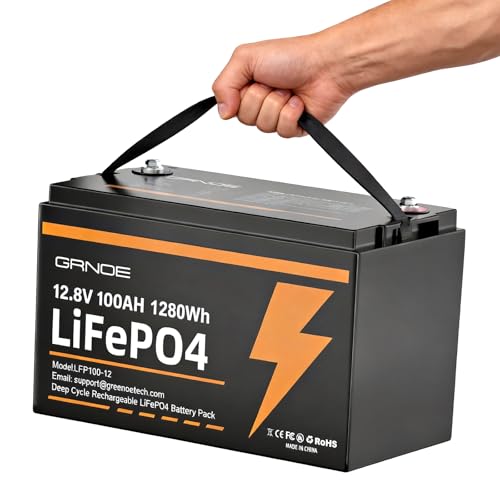
GRNOE 12V 100Ah LiFePO4, Group 31
$159.00A Group 31 case with a 100A BMS at the low end of the price range, the right choice if freezing charge cycles are not part of your camping plan.
Best for: Budget-led single battery replacement.
Check price on Amazon
Super Empower 12V 100Ah LiFePO4, Group 24
$182.99Includes the low-temperature charge cutoff that protects the pack by refusing a frozen charge, though it does nothing to enable charging in the cold the way a self-heating pack does.
Best for: A first lithium conversion in a travel trailer that already has a Group 24 tray.
Check price on Amazon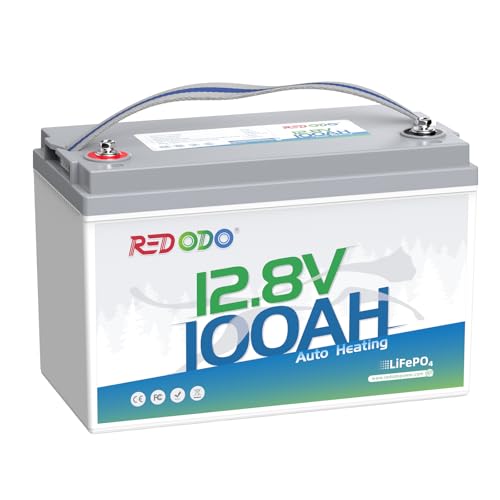
Redodo 12V 100Ah Self-Heating LiFePO4, Group 31
$278.99Draws from the charge source to warm the cells before accepting current, which is what actually lets you charge below freezing rather than just avoiding damage by refusing to.
Best for: Cold season camping where the battery bay drops below freezing.
Check price on Amazon
MARSENERGY 12V 100Ah Self-Heating LiFePO4 with Bluetooth
$249.99Combines self-heating with app reporting, so you can see whether the heater is drawing power before wondering why a charge session is taking longer than expected.
Best for: Cold-weather use where you want visibility into the pack.
Check price on AmazonFrequently asked questions
- Can I charge a standard LiFePO4 battery in freezing weather at all?
- Most standard LiFePO4 batteries include a battery management system that refuses to charge below roughly freezing, protecting the cells by blocking the charge rather than allowing permanent damage. Once the pack warms above that threshold, whether from ambient temperature rising or the compartment being heated another way, normal charging resumes without issue.
- Does self-heating work if the battery is already frozen with zero charge available?
- Self-heating packs need some active charge source connected to trigger the warming cycle, since the heater draws its power from that source. A pack that is fully cold-soaked with no solar, shore power, or alternator connection available will not spontaneously begin heating itself on its own.
- Is self-heating worth it for occasional shoulder-season trips?
- Usually not, if the overnight cold snap is brief and charging mostly happens once temperatures rise later in the day, the standard battery's low-temperature cutoff may rarely or never actually trigger. Reserve the self-heating premium for camping where subfreezing overnight charging is the norm, not the exception.
- How much more does a self-heating battery cost than a standard one?
- In this catalog, a standard 100Ah LiFePO4 battery runs roughly $154 to $183, while a self-heating 100Ah pack runs roughly $250 to $369, a premium of about $70 to $200 depending on the model and whether it includes Bluetooth reporting.
- Can I add an external heating pad to a standard battery instead?
- Aftermarket battery heating pads and insulated battery compartment wraps exist as a separate approach, but they still need to be wired to a power source and controlled to avoid over-discharging the bank just to run the heater. A built-in self-heating pack handles that sequencing automatically as part of its own management system.
- Does self-heating reduce the amount of usable charge I get?
- Yes, some of the power from the charge source goes to running the heating element before any of it goes toward actually charging the cells, which is a real, if usually small, efficiency cost. It is the trade you accept for being able to charge on a normal schedule instead of waiting for temperatures to rise.
- How do I know if my current battery has a low-temperature cutoff?
- Check the manufacturer's spec sheet or the battery management system documentation for a stated minimum charge temperature, often listed near freezing. Nearly every current LiFePO4 battery includes some form of this cutoff as a baseline safety feature, but the exact threshold and how gracefully it recovers once temperatures rise can vary by manufacturer, so confirm the specific number rather than assuming a generic figure applies.
Safety note. Never disable, bypass, or wire around a LiFePO4 battery's low-temperature charge cutoff to force a charge through in freezing conditions, the cutoff exists specifically to prevent permanent, unsafe cell damage. If a standard battery is refusing to charge in the cold, warm the compartment or switch to a self-heating pack rather than forcing current into a frozen cell.