Guides
RV Power in Cold Weather: A Winter Power Guide
Researched from published standards and manufacturer specifications. Updated .
Quick answer
Winter changes three things about an RV power system at once: how the battery accepts a charge, how much load the furnace adds, and how much solar is available to replace what gets used. Each one is a separate, published effect, and a system sized only for summer camping can run into all three at the same time on a cold, short winter day.
This guide covers what actually changes for each battery chemistry, how much more the furnace draws, and how to plan a solar and generator backup around winter's shorter, weaker sun hours.
Can I charge a lithium battery below freezing?
Not without protection. A standard LiFePO4 cell must not accept charge current below freezing, which can permanently damage the cells over repeated exposure. A battery with a built-in low-temperature BMS cutoff will simply stop accepting charge below that threshold and resume once temperatures rise, protecting itself automatically. A self-heating battery goes a step further, pulling a small amount of warmth from the incoming charge source to bring the cells above freezing before allowing current in. Discharging a LiFePO4 battery in cold weather, by contrast, is generally fine and does not carry the same restriction.
What happens to a lead-acid battery in cold weather?
Lead-acid batteries lose usable capacity as the electrolyte gets colder, delivering less energy at a given discharge rate than the same battery would at room temperature. Unlike lithium, lead-acid has no charging restriction tied to freezing temperatures, so it can still be charged normally in the cold. The trade is that a lead-acid bank sized for summer camping may deliver noticeably less usable capacity on a cold winter night than the same battery gave in warmer conditions, even before accounting for the higher furnace load covered next.
How much more power does a furnace actually use in winter?
The furnace itself burns propane, not battery power, but its blower motor runs on 12V and cycles far more often in cold weather to maintain temperature, which is a real and often underestimated addition to the daily amp-hour budget. A blower that barely runs during shoulder-season camping can run for a meaningful share of a cold winter night, and that additional runtime should be added to the daily energy budget calculator rather than assumed away, especially on a system also carrying reduced solar input.
How much less solar can I expect in winter?
Peak sun hours below are published NREL insolation data by region, not an estimate, and the winter-to-summer gap widens sharply at northern latitudes.
| Region | Winter | Summer |
|---|---|---|
| Desert Southwest | 4.5 | 7.0 |
| Mountain West | 3.2 | 6.5 |
| Pacific Northwest | 1.4 | 5.5 |
| New England | 2.2 | 5.2 |
| Midwest | 2.4 | 5.6 |
Published standard Source: NREL insolation data by region, rounded, as tabulated in this site's peak sun hours reference.. A Pacific Northwest array can see winter sun hours fall to roughly a quarter of its summer figure, which is the gap a generator or a larger array has to cover.
How should I resize my solar array or backup for winter?
Run your winter daily energy budget, which should already include the higher furnace blower load, through the solar array calculator using your region's winter peak sun hours figure rather than the annual average. In many regions the array wattage that would fully cover a summer load falls well short in winter, and doubling array size to fully cover winter sun hours is often impractical on a limited roof. A generator sized with the generator size calculator is usually the more realistic winter backup than an oversized array built only for a few dark shoulder-season weeks.
Does state of charge read differently in cold weather?
A resting voltage reading is only accurate on a battery that has been off charge and off load for several hours, and cold temperatures do not change that requirement, they just make it easier to forget while trying to get a quick reading on a cold morning before the battery has settled. A shunt-based monitor avoids this problem entirely by tracking amp-hours rather than voltage, and is worth relying on over a quick voltage check during winter camping when the battery is rarely fully at rest.
What is the practical order of operations for winterizing a power system?
Confirm the battery's cold-charging protection first, either a verified BMS low-temperature cutoff or a self-heating design, before the first freezing night of the season. Recalculate the daily energy budget with winter furnace blower runtime included. Resize expectations for the solar array using winter, not annual, peak sun hours for the region. Size a backup generator for the resulting gap. Add or confirm a shunt monitor, since voltage readings become less reliable to catch casually during winter's shorter charging windows.
Does propane heat change the electrical picture at all?
Propane furnaces and catalytic heaters reduce electrical load compared to running an electric space heater, since the heat itself comes from propane rather than the battery or shore power. The tradeoff is the furnace blower's own 12V draw, covered earlier, and the fact that propane consumption is a separate budget from the electrical one. Comparing the true cost and load tradeoff between propane and electric heat for a specific setup is worth running through the propane versus electric heat calculator rather than assuming one option carries no resource cost at all.
Can condensation or moisture in a cold battery bay cause problems?
A battery bay that swings between a heated interior and a cold exterior can accumulate condensation on connections and terminals, and a damp terminal under load corrodes faster and can develop resistance that shows up as unexpected voltage drop at exactly the connection a multimeter reading would otherwise call fine. Check terminals for corrosion or moisture at the start of a cold season, and make sure any battery bay vents or drains are not blocked by snow or ice, since a sealed and wet compartment is worse than an unsealed and dry one.
Should I insulate or heat the battery compartment itself?
Insulating a battery compartment can reduce how far its internal temperature swings relative to outside air, which helps keep a lithium bank above freezing during cold nights and reduces how much a lead-acid bank's usable capacity drops. Some owners add a small heating pad or a low-wattage heat source specifically for the battery bay in climates with extended freezing stretches, which is a separate load worth adding to the winter daily energy budget rather than assuming it runs for free. A self-heating LiFePO4 battery accomplishes a similar result without needing a separate compartment heater.
What goes wrong with winter power, and how do you catch it early?
The most common failure is charging a standard LiFePO4 battery below freezing without checking whether its BMS actually has a low-temperature cutoff, which can permanently degrade the cells before any symptom shows up in normal use. The second is sizing a winter solar expectation off the annual average sun hours figure instead of the region's specific winter figure, which leaves a real gap between what the array was expected to produce and what it actually delivers on a short winter day. The third is underestimating the furnace blower's added winter load in the daily energy budget, which quietly drains a bank faster than a summer-camping budget would predict. Checking the BMS spec sheet, using winter-specific sun hour figures, and re-running the daily energy budget for winter conditions catches all three before they become a dead battery at a cold campsite.
How does each chemistry actually behave across a temperature range?
| Condition | Lead-acid | LiFePO4 |
|---|---|---|
| Charging above freezing | Normal charge acceptance | Normal charge acceptance |
| Charging below freezing | Still accepts charge normally | Must not charge without a low-temperature BMS cutoff or self-heating cells |
| Discharging below freezing | Reduced usable capacity | Generally fine, no special restriction |
| Usable capacity change in cold | Decreases as electrolyte cools | Not significantly reduced by cold alone |
Published standard Source: Charging and discharging behavior by chemistry documented in manufacturer datasheets and BMS specifications for the batteries in this catalog.. Individual battery low-temperature cutoff thresholds vary by model; check the specific battery's own BMS specification.
Confirm cold-weather charging protection before the first freeze. A standard LiFePO4 battery with no low-temperature cutoff and no self-heating cells should not be charged below freezing. Check the specific battery's BMS behavior rather than assuming any lithium battery handles this automatically.
What to buy for winter power
A self-heating or heated LiFePO4 battery solves the charging problem outright and is worth the added cost for anyone camping through freezing nights regularly. A generator is the practical backup for the days solar cannot keep up, which happens more often in winter at northern latitudes.
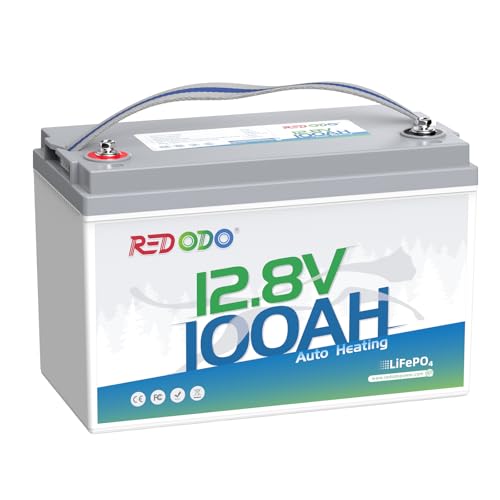
Redodo 12V 100Ah Self-Heating LiFePO4
$269.99Warms itself from the charge source before accepting current, removing the need to track battery bay temperature manually.
Best for: A first cold-weather lithium battery.
Check price on Amazon
LiTime 12V 100Ah RV Self-Heating LiFePO4
$368.99Same self-heating approach in a different form factor for rigs with tighter battery bay dimensions.
Best for: A documented build where the heating current has to be accounted for.
Check price on Amazon
WEN 56477i 4800W RV-Ready Inverter Generator
$634.99Covers the gap when reduced winter sun hours and a higher furnace load outrun what solar alone can replace.
Best for: A 30A rig that needs to run one air conditioner off grid.
Check price on Amazon
Victron SmartShunt 500A Battery Monitor
Price varies, check the listingTracks actual daily amp-hour use, which typically rises in winter from furnace blower run time.
Best for: Any lithium bank you plan to boondock on.
Check price on AmazonFrequently asked questions
- Can I discharge a lithium battery in freezing temperatures?
- Yes, discharging LiFePO4 in cold weather is generally fine and does not carry the same restriction as charging. The limit is specifically on accepting charge current below freezing, which can damage the cells without a low-temperature cutoff or self-heating design in place.
- Why does my lead-acid battery seem weaker in winter?
- Cold temperatures reduce the usable capacity a lead-acid battery can deliver at a given discharge rate, an effect that does not apply to charging the way it does with lithium. The same battery that performed well in warm weather will deliver less usable energy on a cold night, independent of its age or condition.
- Does the furnace itself run off the battery?
- The furnace burns propane for heat, but its blower motor runs on 12V battery power and cycles more often in cold weather to maintain temperature. That increased blower runtime adds a real, often underestimated load to the daily amp-hour budget during winter camping.
- How much does solar output really drop in winter?
- It depends heavily on region, but published NREL sun hour data shows some northern regions dropping to roughly a quarter of their summer output in winter, while desert regions see a smaller relative drop. Check your specific region's winter peak sun hours rather than assuming a flat percentage decrease applies everywhere.
- Do I need a generator for winter camping if I already have solar?
- Often yes, if you camp through winter in a region with a large seasonal sun hour gap. A solar array sized to cover a summer load can fall well short in winter, and a generator sized for the resulting gap is usually more practical than oversizing an array for a few dark weeks a year.
- Is a self-heating lithium battery worth the extra cost over a standard one?
- For anyone regularly camping through freezing nights, generally yes, since it removes the need to manually track battery bay temperature and prevents accidentally charging a cold battery. For a rig that only sees occasional cold snaps, a standard battery with a verified low-temperature BMS cutoff can be an adequate, lower-cost alternative.
- Does cold weather affect how long a fully charged battery holds its charge?
- Cold temperatures do not meaningfully change a battery's self-discharge rate at rest for either chemistry within normal RV storage conditions. The bigger winter effects are reduced lead-acid usable capacity under load and the LiFePO4 charging restriction below freezing, not a faster loss of charge while the battery simply sits unused.
- Do solar panels perform better in cold weather at all, or only worse?
- Panel voltage actually rises slightly in cold temperatures, which can push a small efficiency gain on a clear cold day. That gain is generally outweighed by winter's shorter day length and lower sun angle, which reduce the peak sun hours a region receives overall, so total winter solar output still falls even though the panels themselves are not less efficient in the cold.
A word on safety. Never charge a standard LiFePO4 battery below freezing without a verified low-temperature BMS cutoff or self-heating cells. Recalculate your daily energy budget and solar expectations for winter conditions specifically, rather than reusing a summer plan through the cold season.