Systems
Rooftop vs Portable Solar for RVs: Which Wins Where You Camp
Researched from published standards and manufacturer specifications. Updated .
Quick answer
A rooftop array requires zero setup and cannot be stolen off the pedestal, but it is fixed flat and shades whenever the rig itself is parked in shade. A portable suitcase panel can be carried into a sunny clearing and aimed directly at the sun, which typically matters more than raw wattage once winter sun angles get low. Most RVers are best served by a rooftop array as the primary source, with a portable panel added only if they regularly park in shade.
Rooftop and portable solar are not really competing for the same job. A rooftop array is a fixed installation, bolted down, wired through the roof, and producing power the moment the sun is up with no action from you. A portable suitcase panel is a tool you deploy, unfold, aim, and pack away at every stop, in exchange for the ability to put it somewhere the rig itself cannot reach.
The honest comparison depends entirely on where and how you camp. Someone who parks in open desert BLM land gets little benefit from aiming a portable panel, since the roof array already sees full sun all day. Someone who prefers a shaded, forested campsite loses most of a rooftop array's output to shade and gains real watts from a portable panel moved into the one sunny patch nearby.
Rooftop or portable solar, which should I buy first?
Buy rooftop first if your camping style is mostly open, sunny sites, since a fixed array with zero daily setup will out-produce a portable panel you have to remember to deploy. Buy portable first, or in addition, if you regularly camp under trees, in narrow canyon sites, or anywhere the rig itself throws shade on its own roof for part of the day. The two are not mutually exclusive, and many builds run both, a rooftop array for baseline charging and a portable panel for the days the roof array underperforms.
Rooftop vs portable solar, side by side
The core trade is simple: fixed convenience against the ability to chase the sun. Everything else on this list flows from that one difference.
| Factor | Rooftop array | Portable suitcase panel |
|---|---|---|
| Can be aimed at the sun | No, fixed flat to the roof | Yes, tilted and rotated toward the sun |
| Usable when the rig itself is in shade | No, shades with the rig | Yes, can be moved into a nearby clearing |
| Setup required at each stop | None | Unfold, position, aim, and pack away |
| Theft risk | Low, bolted to the roof | Higher, sits unattended at ground level |
| Typical flat-mount shade and angle derate | About 25 percent versus a panel tilted square to the sun | Minimal, since the panel is aimed |
| Weatherproofing needs | One sealed roof penetration per cable run | None to the roof, but the panel itself is handled and stowed daily |
Convention Source: The roughly 0.75 derate factor for a flat, unangled RV roof panel is a widely used industry rule of thumb versus a panel tilted square to the sun, not a manufacturer-published spec..
Why aiming beats extra watts in the off season
Peak sun hours are not daylight hours, they measure the equivalent hours of full-intensity sun a location receives, and that number drops in winter as the sun sits lower in the sky. A flat rooftop panel loses a larger share of its potential output exactly when peak sun hours are already scarce, because the sun's angle relative to a flat surface gets worse. A portable panel tilted to face that lower sun directly recovers a meaningful share of what a flat roof mount would otherwise lose. Run your specific location and season through the solar charge time calculator to see how much that angle correction is actually worth for your array.
The theft and convenience trade nobody mentions
A portable panel spends its working hours sitting on the ground, often out of sight of the rig, at a campground pedestal or a dispersed camping spot. That is real exposure, and portable solar theft is a known complaint in RV forums. A rooftop array is bolted to the roof and effectively out of reach without tools and time, which is part of why it remains the default for anyone who leaves the rig unattended during the day.
Combining both without overcomplicating the charge controller
The simplest way to run rooftop and portable solar together is to give each its own charge controller feeding the same battery bank, rather than trying to combine both panel sets onto a single controller sized for the sum of their wattage. A rooftop kit that already ships with a matched controller, sized to that array alone, keeps working exactly as installed. Add a portable suitcase panel with its own built-in controller, plug it in only on the days you actually deploy it, and the two charge sources never interfere with each other since each is managing its own panel independently. This also means you are not forced to buy a larger, more expensive controller sized for a combined wattage you will rarely see at the same time, since the portable panel and the rooftop array are producing peak output under different circumstances, one aimed and one flat, rather than simultaneously maxed out in the same conditions.
Output by aim and season, where the gap actually shows up
The rooftop-versus-portable gap is not constant, it widens exactly when the sun sits lower and shade is more likely, which is why the honest comparison has to be broken out by condition rather than given as one number.
| Condition | Flat rooftop panel | Aimed portable panel |
|---|---|---|
| Open sun, high summer sun angle | Full rated output | Full rated output, aiming adds little |
| Open sun, low winter sun angle | Reduced by the flat-mount angle loss | Recovers most of that loss by tilting toward the sun |
| Rig parked in partial shade | Reduced in proportion to the shaded cell area | Unaffected, since the panel is moved into open sun |
| Rig parked in full shade under trees | Near zero output | Full output, if a sunny clearing is reachable nearby |
Convention Source: General solar panel behavior under partial shading and off-angle incidence, a well established characteristic of crystalline silicon panels rather than a single published figure..
The case where portable genuinely beats rooftop
There is a real, specific case where the usual rooftop-first advice inverts: a camper who consistently seeks out shaded, forested sites for comfort. In that scenario the rig's own position guarantees the roof array spends much of the day partially or fully shaded, and no amount of additional rooftop wattage fixes a panel that is sitting in shadow. A portable panel carried twenty or thirty feet into the one sunny gap in the canopy will outproduce a much larger shaded rooftop array in that exact situation. For that specific camper, leading with portable solar and treating rooftop as the optional addition is the more honest recommendation, even though it runs against the general advice that fits most other camping styles.
Rooftop and portable solar picks
Rooftop picks are sized to bolt down once and forget. Portable picks are sized to be carried, aimed, and packed away daily, so weight and fold size matter as much as wattage.

Renogy 100W Monocrystalline Panel
$94.95The reference 100W rooftop panel most RV solar math is written around, easy to add to or scale from.
Best for: A first panel on a small trailer.
Check price on Amazon
Renogy 400W Premium Solar Kit with 40A MPPT
$637.99A full 400W array with a matched 40A MPPT controller in one kit, sized for a roof that gets consistent open sun.
Best for: A full roof array bought as one part number.
Check price on Amazon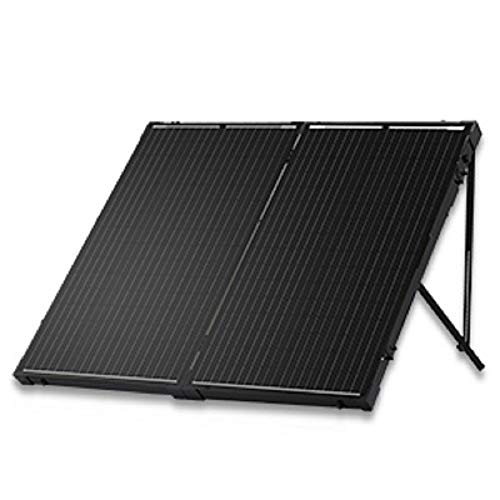
Renogy 200W Portable Solar Suitcase
$322.99A 200W folding suitcase with a built-in controller and adjustable kickstand, so it can be angled directly at the sun from wherever the rig is parked.
Best for: Campers who park under trees on purpose.
Check price on Amazon
BougeRV 200W Foldable Solar Panel
$199.99A fiberglass-backed folding panel that is noticeably lighter than a framed suitcase, which decides whether it actually gets carried out and used.
Best for: Anyone who will actually carry the panel out each morning.
Check price on AmazonFrequently asked questions
- Can I run rooftop and portable solar together?
- Yes, as long as both feed into a charge controller sized for the combined wattage, or each panel set has its own controller wired to the same battery bank. Many boondockers run a rooftop array as the baseline and add a portable panel on shaded days rather than choosing only one.
- Does portable solar charge a battery faster than rooftop?
- Not inherently, watt for watt they produce the same power in identical sun conditions. The advantage shows up when conditions are not identical, since a portable panel aimed at the sun or moved into a sunny clearing can outproduce a shaded or flat-mounted rooftop panel of the same wattage.
- Is portable solar less durable than a rooftop array?
- Foldable and suitcase panels are handled daily and stored between uses, which introduces wear points a permanently bolted rooftop panel never sees, like fold hinges and carrying handles. They are built for that handling, but a rooftop array generally needs less physical care over its lifespan simply because it is not moved.
- How much do I actually gain by aiming a panel in winter?
- The gain scales with how far the sun angle is from square to a flat roof, which is largest in winter and at higher latitudes. Rather than guessing, run your camping location and season through a solar charge time calculator to see the difference angled input makes for your specific array size.
- Do I need mounting brackets for a rooftop panel?
- Yes, standard practice is to raise the panel slightly off the roof surface with Z brackets, which also allows airflow underneath that keeps the cells a little cooler. A cable entry gland box is needed wherever the wiring passes through the roof, sealed to keep water out of that penetration.
- Can portable solar replace a rooftop array entirely?
- For some camping styles, yes, particularly boondockers who move locations often and prefer not to commit to a fixed roof installation. For daily-use full-timers who want charging without a chore attached to it, a rooftop array as the primary source is generally the better fit.
- Does a bigger rooftop array make up for not being able to aim it?
- Adding wattage helps in open sun but does nothing when the panel is shaded, since a shaded cell produces little regardless of the array's total rated size. In a shaded or forested camping style, a smaller aimed portable panel in open sun regularly outproduces a much larger flat rooftop array sitting in shadow, which is why more rooftop watts is not always the fix for a shade problem.
Safety note. Any rooftop cable entry must be properly sealed against water intrusion with a gland box and marine-grade sealant, checked periodically since roof sealant does age and crack. Do not walk directly on solar panels, rooftop or portable, since the cells crack under concentrated foot pressure even when the glass looks intact.