Solar
Best RV Rooftop Solar Panels for 2026
Researched from published standards and manufacturer specifications. Updated .
Quick answer
The Renogy 100W Monocrystalline Panel is the reference RV rooftop panel most solar array math is built around, rated at 100 watts and 12 volts nominal for about $95. Owners with a roof crowded by vents and air conditioners should instead look at the narrower Rich Solar MEGA 100 Slim panel, which trades a somewhat higher price for a frame width that fits between obstacles a standard panel cannot.
Rooftop panels are the permanent, set-and-forget half of an RV solar system, bolted down once and left in place for the life of the rig. The math behind sizing an array starts with peak sun hours for your camping region, not total daylight hours, because peak sun hours already account for the sun's angle and atmospheric losses across the day. A flat RV roof also loses output to a conventional derate of roughly 0.75 against a panel's rated wattage, since the panel is rarely tilted toward the sun the way a ground-mounted array would be.
This roundup compares four 100W panels by the specifications that actually change installation and output: cell technology, busbar count, and frame width. All four are readily combined into larger arrays, so the right pick often comes down to how much room your roof actually has left after vents, an air conditioner, and any existing hatches.
How we chose these RV rooftop panels
We did not test any of these panels in person. Rankings come from published wattage, cell type, and busbar specifications on each manufacturer's listing, along with verified owner reviews describing real-world output and frame durability after roof installation. Where a listing did not publish an efficiency percentage independently verified by a third party, we describe it as a manufacturer claim rather than a confirmed figure.
How many watts of rooftop solar do you actually need?
Sizing an array starts with your daily amp-hour draw, not with how many panels will physically fit on the roof. Peak sun hours, which measure the equivalent hours of full-strength sunlight per day for a given region and season, are the number to use, not total daylight hours, since a location can have 14 hours of daylight and only 5 peak sun hours. Run your numbers through a solar array calculator and check your camping region against a peak sun hours by region reference before deciding how many panels to buy.
Rooftop panels compared
All four panels here are rated at 100 watts and 12 volts nominal. The differences are cell technology, busbar count, which affects how well the panel tolerates partial shading, and physical width, which matters when panels have to be squeezed around roof obstructions.
| Panel | Cell type | Busbars | Price |
|---|---|---|---|
| Renogy 100W N-Type | N-type monocrystalline | 16 | $102.73 |
| Renogy 100W Monocrystalline | Monocrystalline | Not published | $94.95 |
| JJN 100W | Monocrystalline | 10 | $59.99 |
| Rich Solar MEGA 100 Slim | Monocrystalline | Not published | $119.99 |
Published standard Source: Manufacturer spec sheets on the product listings, current at time of writing..
Narrow-roof and shade-heavy roofs
A crowded roof with an air conditioner, a couple of vent fans, and an antenna leaves oddly shaped open space, and that is exactly the situation the Rich Solar MEGA 100 Slim panel is built for, with a narrower frame than a standard 100W panel so it can fit into a gap a wider panel cannot. If your roof has partial shading from any of those obstructions during part of the day, the N-type cells on the Renogy panel also hold output better under partial shade than standard monocrystalline cells, for owners who would rather solve the shading problem with cell technology than with panel width.
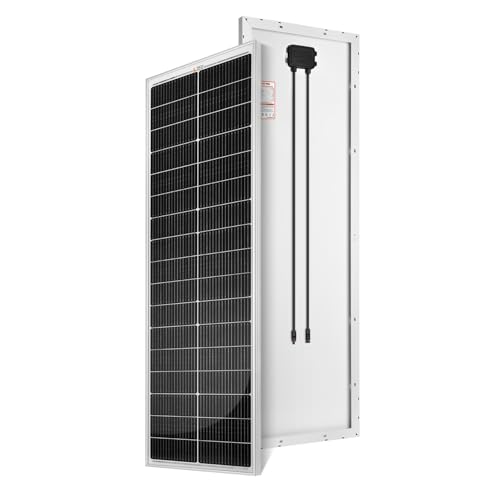
Rich Solar MEGA 100 Slim Panel
$119.99A narrower frame than a standard 100W panel, which is what lets an extra panel fit between roof obstructions.
Best for: Roofs where the limit is width, not budget.
Check price on Amazon
Renogy 100W N-Type Monocrystalline Panel
$102.73N-type cells with 16 busbars hold output better in partial shade, which is the usual condition on an RV roof full of vents.
Best for: Building a roof array one panel at a time.
Check price on AmazonHow dirt and debris cut panel output
A rooftop panel accumulates road film, tree sap, and dust over a season, and even a thin layer of grime measurably reduces the amount of light reaching the cells underneath. Panels mounted flat on an RV roof do not get the self-cleaning benefit of rain running off a steeply tilted ground-mounted array, so periodic rinsing with plain water, done safely from a ladder rather than while the roof is in use, keeps output closer to what the panel is actually rated for. Bird droppings and fallen leaves are worse than general dust because they can fully shade individual cells, and depending on how a panel's cells are wired, shading even one cell can disproportionately reduce the output of the whole panel rather than just that one section.
Panels alone are not a kit: what else you need
A rooftop panel purchased on its own still needs mounting hardware and a sealed roof penetration for the cabling. Z brackets raise the panel off the roof surface so air can move underneath and keep the cells cooler, and a proper cable entry gland with sealant is what actually prevents the roof penetration from leaking, which is the most common point of failure in a self-installed array. The BougeRV and Link Solar double cable glands both bring two panel cables through the roof in a sealed housing; either works, and the choice mostly comes down to which one's profile sits flattest on your specific roof material. If you are buying panels individually rather than as a kit, budget for brackets and a gland before you start drilling.

Renogy Solar Z Brackets, 4 Sets
$37.99Enough brackets for a four panel array bought in one go, which is usually cheaper than two 2-packs.
Best for: A 400W four-panel roof.
Check price on Amazon
BougeRV Double Cable Entry Gland Box
$9.99The roof penetration is where a solar install leaks. A proper gland box with sealant is the part that prevents it.
Best for: Bringing two solar cables through the roof.
Check price on Amazon
Link Solar Weatherproof Double Entry Gland
$9.89A low, rounded profile that sheds water rather than damming it behind the box.
Best for: A tidy roof entry on a flat roof.
Check price on AmazonEstimated daily output at different peak sun hour levels
Using the conventional 0.75 derate for a flat, unshaded RV roof, a 100W panel's realistic daily output scales directly with how many peak sun hours your camping region and season provide. These are estimates from the derate convention applied to rated wattage, not a measured result from any specific panel.
| Peak sun hours | Estimated daily output |
|---|---|
| 3 hours | 225Wh |
| 5 hours | 375Wh |
| 7 hours | 525Wh |
Convention Source: Calculated as rated watts multiplied by peak sun hours multiplied by the conventional 0.75 flat-roof derate.. Actual output varies with panel angle, temperature, shading, and cell technology, and this table does not account for any of those individually.
What a rooftop array will not do
A modest rooftop array will not fully power a residential air conditioner, and it will not keep a large battery bank topped up through several consecutive overcast or heavily shaded days, since output on those days can fall well below the peak sun hour estimates above. Rooftop solar is best understood as offsetting daily consumption and slowing how fast a battery bank drains while boondocking, not as a guaranteed, unlimited power source regardless of weather. Pairing an array with a properly sized battery bank, and having a backup charging plan such as a generator or alternator charging for stretches of poor weather, is how most boondockers actually use rooftop solar in practice.
Apply the 0.75 flat-roof derate before you buy, not after. A 400W array bolted flat to an RV roof will realistically deliver output closer to 300W of average daily production once you account for the sun's angle relative to a horizontal panel, so size the array to your actual power needs using that convention rather than the panels' rated wattage alone.
The best RV rooftop solar panels by tier
Do not pay the N-type premium if your roof is genuinely open with no shading from vents, antennas, or air conditioners. The efficiency advantage of N-type cells shows up specifically in partial shade conditions, and on a clear roof a standard monocrystalline panel at a lower price performs almost identically.
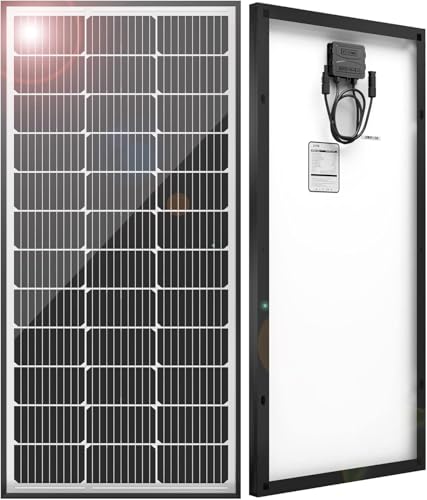
JJN 100W Monocrystalline Panel
$59.99The lowest cost per watt among rigid panels here, which adds up quickly once you are buying three or four of them.
Best for: Filling a roof on a budget.
Check price on Amazon Renogy 100W Monocrystalline Panel
$94.95A well-documented 100W monocrystalline panel that is easy to combine with other panels of the same rating without guessing at compatibility.
Best for: A first panel on a small trailer.
Check price on Amazon Renogy 100W N-Type Monocrystalline Panel
$102.73N-type cells with 16 busbars hold output better in the partial shade an RV roof full of vents produces, at a price premium over standard monocrystalline.
Best for: Building a roof array one panel at a time.
Check price on AmazonFrequently asked questions
- How many 100 watt panels do I need to run an RV air conditioner off solar?
- There is no single answer, because it depends on your battery bank size, your inverter, and how long you need the air conditioner to run. Rooftop solar realistically keeps a battery bank topped up for other loads rather than running an air conditioner directly and continuously. Size the full system, panels, battery bank, and inverter together with a solar array calculator instead of estimating from panel count alone.
- What is the difference between monocrystalline and N-type cells?
- Both are monocrystalline silicon, but N-type cells use a different doping process that reduces a form of efficiency loss called light-induced degradation and typically holds output better in partial shade and at higher temperatures than standard P-type monocrystalline cells. The trade-off is usually a higher price per watt for panels built with N-type cells.
- Do I need Z brackets to mount a rigid panel?
- Z brackets are the standard mounting method for rigid rooftop panels because they raise the panel slightly off the roof surface, allowing airflow underneath that helps keep the cells cooler and marginally more efficient. Some owners mount panels flush with adhesive-only mounting tape instead, but that sacrifices the airflow benefit and makes future panel removal more difficult.
- How do I run panel cables through the roof without leaking?
- A dedicated cable entry gland box, sealed with compatible roof sealant on all sides, is the standard method for bringing solar cables through an RV roof. Avoid drilling a single small hole and relying on sealant alone, since a proper gland box is designed to shed water away from the penetration rather than let water sit against it.
- Will rooftop panels fully charge my battery when parked in shade?
- Rooftop panels lose most of their output in significant shade, since even partial shading across part of a panel can disproportionately reduce the whole panel's production depending on how the cells are wired. If you regularly park under trees, a portable suitcase panel that can be moved into open sun is generally more effective than a larger rooftop array on a permanently shaded roof.
- Can I mix different panel brands in one array?
- Panels of the same wattage and voltage rating from different manufacturers can generally be wired together, but matching voltage and current characteristics as closely as possible avoids one panel limiting the output of the others in the string. For a first array, buying panels of the same wattage rating, even from different brands, keeps the wiring math straightforward.
Measure your roof before you order panels. Vents, air conditioners, and antennas eat into usable roof space fast, and a panel that looks affordable on its own is not a good deal if it does not physically fit the space you actually have left.