Batteries
Lead-Acid vs Lithium: True Cost Per Cycle for an RV Battery
Researched from published standards and manufacturer specifications. Updated .
Quick answer
A 100Ah LiFePO4 battery selling for around $153 to $200, with a manufacturer's published listing claim of up to 15,000 cycles on some models, works out to a fraction of a cent per cycle on the battery cost alone. A 100Ah AGM battery at a similar or higher price does not publish a cycle count on its listing at all, which means its true cost per cycle cannot be calculated from the manufacturer's own numbers.
Cost per cycle sounds like a simple division problem: purchase price divided by the number of charge and discharge cycles a battery survives. It only works, though, if both numbers in that fraction are real. The purchase price is easy to find. The cycle count is where lead-acid and lithium listings genuinely diverge, because several LiFePO4 batteries in this catalog carry a specific manufacturer-published cycle claim on their listing, while none of the AGM batteries compared here publish one at all.
That gap is itself part of the honest answer. Lithium usually wins the cost-per-cycle argument, not because every number is confirmed by independent lab testing, but because the price premium over lead-acid is modest, commonly 1.2 to 1.7 times, while the manufacturer-published cycle life claims for lithium run into the thousands where lead-acid listings in this catalog offer no comparable published number at all.
What does "usable capacity" mean, and why does it change the math?
A 100Ah battery rating describes total capacity, not the amount you should actually draw out before recharging. Convention holds lead-acid to roughly 50 percent depth of discharge to preserve its lifespan, meaning a 100Ah lead-acid battery gives about 50Ah of usable capacity per cycle. LiFePO4 tolerates a much deeper discharge without the same damage, and convention treats a 100Ah lithium battery as giving about 80Ah usable. That difference means a lead-acid and a lithium battery of the same rated amp-hours are not actually delivering the same usable energy per cycle, which matters before any cycle-count comparison even starts.
Published figures for a 100Ah battery, lead-acid against lithium
| AGM lead-acid (uplus-100ah-agm) | LiFePO4 (grnoe-100ah-g31) | |
|---|---|---|
| Price | $189.99 | $159.00 |
| Rated capacity | 100Ah | 100Ah |
| Usable capacity per cycle | ~50Ah (conventional 50% depth of discharge) | ~80Ah (conventional 80% depth of discharge) |
| Manufacturer cycle claim on listing | Not published | Up to 15,000 deep cycles, per manufacturer listing |
| Cost per cycle | Cannot be calculated, no published cycle count | Roughly $0.011 per cycle at the manufacturer's stated cycle count |
Convention Source: Usable depth-of-discharge figures are standard RV/solar conventions for lead-acid and LiFePO4. Cycle claim and price are taken directly from each product's current manufacturer listing.. The lithium cycle figure is the manufacturer's own published claim on the specific listing, not an independently verified test result. It is used here because it is the only cycle number either manufacturer actually publishes.
Why does not the lead-acid battery in this catalog publish a cycle count?
Lead-acid deep-cycle batteries at this price point, aimed at a general RV and marine market, commonly market themselves on capacity, weight, and build quality rather than a headline cycle number, and none of the AGM listings pulled for this catalog state one. That is not unusual for the category, but it does mean a shopper comparing the UPLUS 12V 100Ah Deep Cycle AGM against a lithium alternative cannot finish the cost-per-cycle calculation using the manufacturer's own published numbers the way they can with several of the lithium batteries here. Where a cycle count is not published, the honest move is to say so rather than estimate one, which is exactly the gap this table shows.
What other costs sit outside the per-cycle number entirely?
Cost per cycle only accounts for the battery purchase price against its usable life, and it leaves out real costs that fall on one side more than the other. A lithium conversion commonly needs a converter or charger with a genuine lithium charge profile, since a stock lead-acid converter will never bring a LiFePO4 bank to a true full charge, which is an added cost a straight lead-acid replacement does not carry. Lead-acid carries its own outside costs: a 200Ah AGM battery weighing around 120 pounds adds real payload and can require reinforced mounting that a lighter lithium pack does not.
Neither of these outside costs is large enough to flip the basic conclusion for most readers, but they are worth budgeting alongside the battery price itself rather than assuming the sticker price is the whole story on either chemistry.
How skeptical should I be of a "15,000 cycles" claim?
Treat it as the manufacturer's own marketing figure on that specific listing, not an independently tested result, because nothing in the products compared here is independently verified. What matters for the cost-per-cycle argument is not whether 15,000 is exactly accurate, but the size of the gap between it and a lead-acid battery that publishes no comparable number at all. Even a lithium battery that fell dramatically short of its stated claim would need to underperform by an extreme margin before the math stopped favoring it over a lead-acid battery selling at a similar or higher price with no stated cycle life to compare against in the first place.
Does a bigger lithium bank change the per-cycle economics?
The per-cycle logic scales the same way regardless of bank size, since it is a ratio of price to cycles and usable capacity rather than an absolute dollar figure tied to one battery. The Yeagulch 12V 200Ah LiFePO4 at $316.59 also carries a manufacturer listing claim of 15,000-plus deep cycles, at roughly double the capacity of the 100Ah packs above for less than double the price, which is the usual shape of lithium pricing in this catalog. The comparison against lead-acid does not change qualitatively at the larger size; it is the same modest price premium set against the same large gap in what each side publishes about cycle life.

Yeagulch 12V 200Ah LiFePO4
$316.59A 200A BMS is the spec that matters here, because a 2000W inverter can pull close to 200A from a 12V bank at full load.
Best for: A single-battery bank that has to run a 2000W inverter.
Check price on AmazonA published cycle claim assumes correct charging and storage. Neither lead-acid nor lithium batteries reach their potential lifespan if routinely over-discharged, left partially charged for long periods, or charged with the wrong profile. Use a converter or charger with a genuine lithium profile on a LiFePO4 bank, since a lead-acid charge curve will never bring a lithium bank to a true full charge.
The batteries behind this math
Prices and any published cycle claims are pulled from each battery's own current listing. Where a battery does not publish a cycle count, that is stated plainly rather than filled in with a guess.
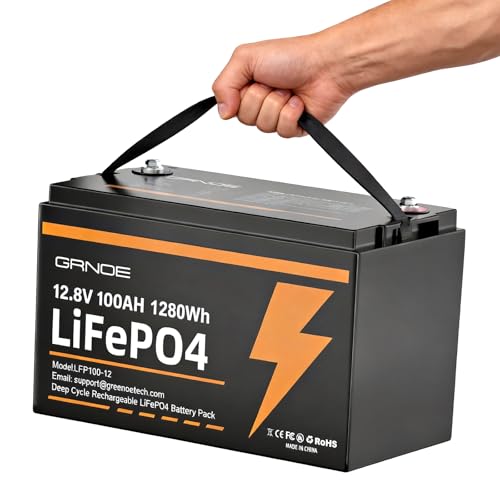
GRNOE 12V 100Ah LiFePO4, Group 31
$159.00GRNOE's own listing states up to 15,000 deep cycles at $159.00, the least expensive of the batteries here with a stated cycle claim.
Best for: Budget-led single battery replacement.
Check price on Amazon
Vemdia 12V 100Ah LiFePO4, Group 31
$153.99Vemdia's listing states 15,000-plus deep cycles and a 10-year lifespan, priced at $153.99.
Best for: Replacing a single Group 31 lead-acid battery.
Check price on Amazon
UPLUS 12V 100Ah Deep Cycle AGM, Group 27
$189.99The cheapest honest deep-cycle AGM in this catalog at $189.99, with no cycle count published on its listing.
Best for: The cheapest honest deep cycle option.
Check price on Amazon
Renogy 12V 200Ah Deep Cycle AGM
$395.99A 200Ah AGM at $395.99, roughly 120 pounds, giving about 100Ah usable at the conventional 50 percent depth of discharge for lead-acid.
Best for: A large lead-acid bank where weight is not a constraint.
Check price on AmazonFrequently asked questions
- Is lithium really cheaper per cycle than lead-acid?
- Based on the numbers each manufacturer actually publishes in this catalog, yes: several LiFePO4 batteries state cycle counts in the thousands at a price only modestly above comparable AGM batteries, while none of the AGM batteries here publish a cycle count at all. The honest caveat is that the lithium cycle figure is the manufacturer's own listing claim, not an independent test result.
- Why do lead-acid batteries not publish a cycle count the way lithium does?
- It varies by manufacturer and price tier rather than being universal to the chemistry; some lead-acid makers do publish cycle life at a given depth of discharge. None of the AGM batteries pulled for this specific catalog state one on their listing, which means that particular number simply is not available for those products, and should not be estimated or invented in its place.
- What depth of discharge should I actually use for lead-acid vs lithium?
- Convention holds lead-acid to roughly 50 percent depth of discharge to protect its lifespan, and LiFePO4 to roughly 80 percent, which is why a 100Ah rating does not mean the same usable amp-hours on both chemistries. These are widely used conventions in RV and solar system sizing, not a rule enforced by any single published standard.
- Should I trust a "15,000 cycles" claim on a battery listing?
- Treat it as the manufacturer's own published marketing figure rather than an independently verified result, since nothing here has been separately tested. It is still meaningful for comparison purposes, because it is the only cycle number that manufacturer has put in writing, and the gap between that figure and a lead-acid listing with no cycle count at all is large enough to matter even if the real number runs lower.
- Does a higher upfront price always mean a better cost per cycle?
- No. Cost per cycle depends on price divided by both cycle life and usable capacity, so a cheaper battery with a strong published cycle count can beat a pricier one with a weaker or unpublished figure. Compare the actual numbers on the specific listing you are buying rather than assuming price alone predicts cost per cycle.
- How much does weight factor into the lead-acid vs lithium cost comparison?
- Weight is not part of the cost-per-cycle math directly, but it is a real practical cost. A 200Ah AGM battery weighs around 120 pounds for roughly 100Ah usable, while a 100Ah LiFePO4 battery delivering 80Ah usable typically weighs a fraction of that. That difference affects installation, tongue or axle weight, and whether the battery can be lifted by one person, none of which shows up in a pure dollar-per-cycle number.
When a manufacturer does not publish a cycle count, do not fill in the blank yourself. Compare only the figures actually stated on each listing, and treat any unpublished number as genuinely unknown rather than assuming a typical industry figure applies to a specific battery that never states one.