Shore power
Best RV Shore Power Cords and Dogbone Adapters
Researched from published standards and manufacturer specifications. Updated .
Quick answer
The Camco PowerGrip dogbone adapter is the standard choice for plugging a 30 amp RV into a 50 amp pedestal, converting the NEMA 14-50 receptacle down to the TT-30 plug a 30 amp cord uses. An adapter never increases available amperage: a 30 amp rig on a 50 amp pedestal still has only 30 amps total, and a 50 amp rig stepped down to a 30 amp pedestal also has only 30 amps for the whole coach.
A shore power cord and a dogbone adapter solve two different problems. The cord connects the coach to a pedestal at the same amperage the coach is rated for. An adapter changes which physical receptacle you can plug into, stepping a 50 amp pedestal down to a 30 amp plug or the reverse, but it never changes how many amps are actually available to the rig. That distinction matters because plugging a 50 amp coach in through a 30 amp adapter means the entire coach, both air conditioners and everything else, is now sharing a single 30 amp circuit, not the 12,000 watts of a full 50 amp service.
The picks below cover replacement cords for a damaged original and dogbone adapters for both directions, 50 to 30 and 30 to 50.
Does an adapter give my rig more amps?
No, and this is the single most misunderstood point about shore power adapters. A dogbone adapter changes the physical plug shape so a cord can reach a different receptacle; it does not add capacity. A 30 amp rig plugged into a 50 amp pedestal through an adapter still has 30 amps total, because the rig's own wiring, breaker and cord are all rated for 30 amps regardless of what the pedestal can supply. A 50 amp rig stepped down to a 30 amp pedestal through the reverse adapter has only 30 amps for the entire coach, meaning both air conditioners cannot run at once without tripping the pedestal's breaker. Plan loads around the adapter's limit, not the rig's normal rating.
How we chose these cords and adapters
We did not test these in person. These picks come from published manufacturer specifications, the gauge and connector ratings each product lists, and verified owner reviews describing real-world durability at the inlet and plug connections over repeated use. Cord gauge and connector type are standard, published figures, not something we estimated.
NEMA receptacle reference
Every cord and adapter here is built around two standard NEMA device ratings. The table below lays out what each one actually delivers.
| Receptacle | Amps | Voltage | Approx. watts | Legs |
|---|---|---|---|---|
| TT-30R (30A RV) | 30 | 120V | 3,600 | 1 |
| NEMA 14-50R (50A RV) | 50 | 120/240V split | 12,000 | 2 |
Published standard Source: NEMA TT-30 and NEMA 14-50 device rating standards.. A 50 amp service is two separate 120V legs, not a single higher-rated leg.
How long should my shore power cord be?
25 feet is the standard length for a factory-style RV cord and reaches most pedestals from a normal parking position without excess coiled cable lying on wet ground. A longer run is sometimes unavoidable at an awkward site, but running a cord longer than needed increases voltage drop under load, which works against everything an EMS is trying to prevent. If a site regularly requires more length, a properly rated extension built for RV amperage is the better fix than routing one long cord across the whole site.
Should I ever use a cord or adapter with a cracked or damaged plug?
No. A cracked plug body or bent, corroded pins is one of the more common causes of an arcing connection at the pedestal, which can generate real heat right at the point where you are standing to plug in. Replace a damaged cord or adapter outright rather than taping or forcing it, and inspect the plug ends at both the pedestal side and the coach inlet each time you connect for a stay longer than a night or two.
Storing a shore power cord and adapters between trips
Coil a shore power cord loosely rather than in tight loops, since a tight coil stresses the conductors at the same points every time and can eventually crack the insulation from repeated flexing in the same spots. Store both the cord and any dogbone adapters somewhere dry, since a damp cord bay left closed for weeks between trips is a common cause of corrosion at the plug and receptacle pins, particularly on the small brass contacts inside a dogbone adapter. A quick inspection of both ends before each trip catches most of this early, well before a corroded pin becomes a connection that arcs or overheats at the pedestal.
Why do some campgrounds only offer household outlets?
Tent sites and some older or smaller campgrounds sometimes only provide a standard 15 or 20 amp household-style outlet rather than a true 30 amp TT-30R or 50 amp NEMA 14-50 RV receptacle. A 30 amp to household adapter exists for this situation, but it limits the coach to whatever the household circuit can actually deliver, often far less than 30 amps, which means running only minimal loads, no air conditioning, while connected that way. This is a different situation from the 50 amp to 30 amp or 30 amp to 50 amp dogbones covered on this page, which step between two RV-rated circuits rather than down to a residential one.
Should the cord run through the same access point every time?
Running the cord through a dedicated cord port or a specific gap near an awning or slide-out, rather than a different gap each time, reduces wear at the one point where the cord is most likely to get pinched or abraded against a sharp edge. If the coach does not have a dedicated cord port, a rubber grommet or a section of split loom at the pinch point is a cheap way to protect the cord jacket from a metal edge it crosses every single time it is deployed.
Is 10 gauge always correct for a 30 amp cord?
10 AWG is the standard gauge manufacturers use for a 30 amp RV cord at typical lengths around 25 feet, and every 30 amp cord on this page uses that gauge. A meaningfully longer run, well beyond 25 feet, is where a heavier gauge starts to matter to keep voltage drop in check, which is another reason to prefer a properly rated extension over one very long custom cord.
Never modify a cord or adapter, and never use a cheater plug that bypasses the ground pin. An open ground is exactly the fault an EMS is built to catch, and defeating it on purpose removes a real safety protection rather than working around an inconvenience.
Best cords and adapters by experience level
Cords replace a damaged original at the same amperage. Adapters change which pedestal receptacle you can use, in either direction, without changing your rig's actual amperage.

Cable Matters 30A 25ft RV Power Cord
$54.99A straightforward replacement cord at the standard 25 foot length, which reaches most pedestals from a normal parking position without an extension.
Best for: Replacing a damaged original cord.
Check price on Amazon
RVGUARD 30A 25ft Cord with Polarity Indicator
$53.99A built-in reverse polarity indicator flags a miswired pedestal before you connect the coach to it, which matters most at older campgrounds with questionable wiring.
Best for: Older parks with questionable pedestals.
Check price on Amazon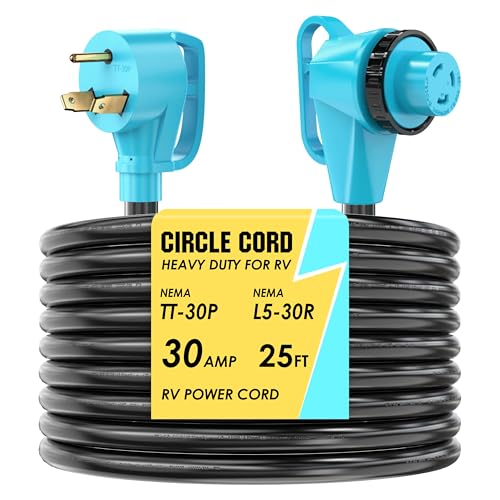
CircleCord 30A 25ft RV Power Cord
$69.69A right-angle twist-locking end takes strain off the inlet, the point where cords most often fail, and is worth the extra cost for anyone plugging and unplugging constantly rather than parking for a season; skip this tier if the cord mostly stays connected in one spot.
Best for: A cord that gets plugged and unplugged constantly.
Check price on Amazon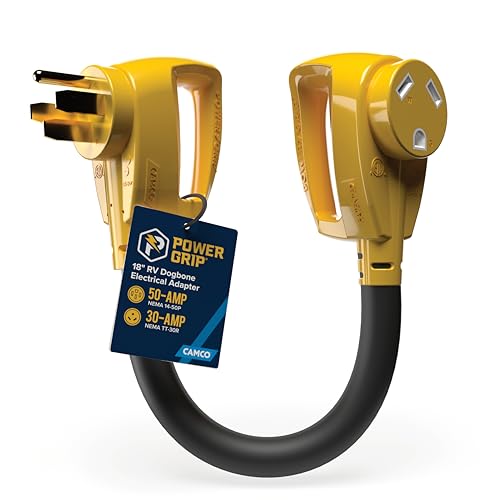
Camco PowerGrip Dogbone, 50A Male to 30A Female
$16.11The standard 50 amp to 30 amp dogbone, for a 30 amp rig parking on a 50 amp pedestal.
Best for: A 30A rig at a 50A pedestal.
Check price on Amazon
ELEGRP 50A to 30A Dogbone Adapter
$19.99The same direction as the Camco adapter, NEMA 14-50P to TT-30R, at a lower price point with the same function.
Best for: A 30A rig in a 50A site.
Check price on Amazon
ELEGRP 30A to 50A Dogbone Adapter
$19.19The reverse direction, TT-30P to 14-50R, for a 50 amp rig at a 30 amp pedestal; remember this genuinely limits the whole coach to 30 amps total, it does not restore 50 amp capacity.
Best for: A 50A rig at a 30A pedestal, with loads managed accordingly.
Check price on AmazonFrequently asked questions
- Does a 50 amp to 30 amp dogbone adapter give my 30 amp rig more power?
- No. The adapter only changes the plug shape so a 30 amp cord can connect to a 50 amp pedestal's receptacle. The rig's own cord, breaker and wiring are still rated for 30 amps, roughly 3,600 watts, regardless of how much the pedestal itself can supply. Load management for a 30 amp rig stays exactly the same whether it is plugged into a 30 amp or a 50 amp pedestal through an adapter.
- What happens if I plug a 50 amp rig into a 30 amp pedestal with an adapter?
- The entire coach is limited to 30 amps total, about 3,600 watts, shared across both air conditioners, the converter and everything else. Running two air conditioners at once will typically trip the pedestal's breaker under that limit, so loads need to be managed much more carefully than the rig's normal 50 amp, 12,000 watt capacity allows.
- What gauge wire should a 30 amp RV cord use?
- 10 AWG is the standard gauge for a 30 amp RV shore power cord, sized to safely carry a 30 amp continuous load over typical cord lengths without excess voltage drop or heating. Check the gauge stamped on the cord jacket if you are replacing a damaged one, since a thinner gauge is not rated for the same load.
- How do I know if my campground pedestal is wired backwards?
- A cord or EMS with a built-in reverse polarity indicator will show a fault the moment you connect, before power reaches the coach's own wiring. Without that indicator, reverse polarity can go unnoticed until it damages something downstream, since many appliances still appear to run normally on swapped hot and neutral for a short time.
- Can I daisy-chain two adapters together to go from 50 amp to 30 amp and back?
- It is not recommended. Stacking adapters adds connection points, each one a potential source of resistance, heat and a loose fit, and it does nothing to restore lost amperage in either direction. Use the single correct adapter for the direction you actually need instead of combining two.
- How often should I replace an RV shore power cord?
- There is no fixed schedule; replace it when you see cracked insulation, bent or discolored pins, or any sign of heat damage at the plug ends. A cord that gets plugged and unplugged at a different pedestal every few days wears out faster than one that stays connected for a season, so frequent travelers should inspect their cord ends more often.
An adapter changes the plug, never the amps. Plan every load around whichever amperage is actually limiting the connection, the rig's own rating or the adapter's, whichever number is smaller.