Shore power
30 Amp vs 50 Amp RV Shore Power Service Explained
Researched from published standards and manufacturer specifications. Updated .
Quick answer
Comparing 30A and 50A shore power by amperage alone is the single most common sizing mistake in RV electrical. The two services do not just differ by amperage, they differ in how many hot legs they carry, and that structural difference is what actually decides how much you can run at once.
This page breaks down the real wattage available on each service, per NEMA device ratings, and what actually happens when you adapt one to the other.
This distinction matters most at the moment you are deciding whether an adapter will let you do something the plug shape alone suggests it should. Plugging a 50A rig into a 30A pedestal through an adapter looks, from the plug end, like a normal connection, but the total power available behind that plug has dropped to a fraction of what the rig is built to draw, and nothing about the adapter itself warns you of that.
Does a 50A RV service really give you more than three times the power of 30A?
Yes, and this is the part most owners get wrong by comparing 30 and 50 directly as if they were the same kind of circuit. A 30A RV service is a single 120V leg, so total available power is 120V times 30A, or 3,600 watts. A 50A RV service is two separate 120V legs, each rated 50A, so total available power is 120V times 50A times two legs, or 12,000 watts. Going from 30A to 50A looks like a 67 percent increase in amperage, but because 50A service adds a second leg, the actual power increase is more than three times, not two thirds more.
30A vs 50A shore power head to head
These figures follow NEMA TT-30 and NEMA 14-50 device ratings, a published electrical standard, not a manufacturer estimate.
| Factor | 30A service (NEMA TT-30) | 50A service (NEMA 14-50) |
|---|---|---|
| Hot legs | One 120V leg | Two separate 120V legs |
| Rated amperage per leg | 30A | 50A per leg |
| Total available power | 120V x 30A = 3,600W | 120V x 50A x 2 legs = 12,000W |
| Power increase, 30A to 50A | More than 3x, not 67% more | |
| Plug configuration | 3-prong | 4-prong |
| Typical use case | Smaller trailers, one AC unit | Larger rigs, two AC units, electric appliances |
Published standard Source: NEMA TT-30 and NEMA 14-50 device ratings.. These are the ratings of the shore power connection itself. A specific RV’s main breaker, wiring and appliance load may be lower than the full rated capacity of its service.
What an adapter actually does, and does not do
A dogbone adapter changes which plug shape fits the pedestal. It never changes the amperage actually available to the rig. A 30A rig plugged into a 50A pedestal through an adapter is still limited to 30A total, because the rig's own wiring, breaker and shore power cord are rated for 30A regardless of what the pedestal can supply. A 50A rig plugged into a 30A pedestal through the reverse adapter is limited to 30A total while connected there, a large cut from its normal 12,000 watt capacity, so load management matters far more on that connection.
How to size loads for each service
On a 30A service, running one air conditioner near its startup draw already uses a large share of the 3,600 watt total, leaving little headroom for a microwave or a second high-draw appliance at the same time. On a 50A service, the two legs are typically split so each leg feeds different circuits, giving roughly 6,000 watts of headroom on each leg rather than one shared 3,600 watt pool, which is why larger rigs with two air conditioners are built around 50A service rather than 30A.
How to tell which service your rig actually has
Look at the shore power plug on the cord itself before assuming anything from the RV's size or class. A 30A plug has three prongs; a 50A plug has four prongs and is visibly larger. This matters because some mid-size rigs are built with 50A service despite looking similar in size to a 30A trailer, and the only way to know for certain is to check the plug, or check the main breaker panel inside, which will be labeled for the service size.
Does a 50A rig ever not need the full 12,000 watts?
Often, yes. Many 50A rigs rarely draw anywhere near 12,000 watts at once in normal use, since that figure is the ceiling the wiring and breakers are built to handle, not a typical operating load. Two air conditioners running together with some other loads might reach 4,000 to 6,000 watts, well under the ceiling. The 50A service exists to provide headroom for peak conditions, startup surges on multiple compressors at once, and future load growth, not because every 50A camping session needs the full rating.
What happens if a campground pedestal cannot actually deliver its rated amperage
Older or poorly maintained pedestals sometimes deliver less voltage or amperage than their receptacle rating implies, particularly at busy parks during peak demand when many rigs are drawing simultaneously. This is a separate problem from the 30A versus 50A comparison itself, but it is the reason an EMS matters regardless of which service size you run: a pedestal sagging to a low voltage under load can damage sensitive electronics even though the physical plug and receptacle rating look correct. Checking actual delivered voltage at the pedestal, which an EMS does automatically, catches this before it reaches your rig's wiring.
An adapter never increases available amperage. Whichever side of a dogbone adapter has the lower rating sets the real limit for the whole connection. Size your loads to the smaller of the two ratings whenever an adapter is in use.
Which adapter or protector to buy
Buy the EMS that matches your rig service, always. Buy a dogbone adapter only to change which pedestal shape you can plug into, never expecting it to change how much power is actually available. The direction of the adapter tells you which limit applies: whichever side has the smaller amperage rating caps the whole connection.

Progressive Industries EMS-PT50X, 50A
$187.15Watches both 120V legs independently for low voltage, high voltage, open ground and reverse polarity.
Best for: Any 50A rig.
Check price on Amazon
Progressive Industries EMS-PT30X, 30A
$135.89Same disconnect protections sized for a single 120V, 30A leg.
Best for: Anyone plugging into parks they have not vetted.
Check price on Amazon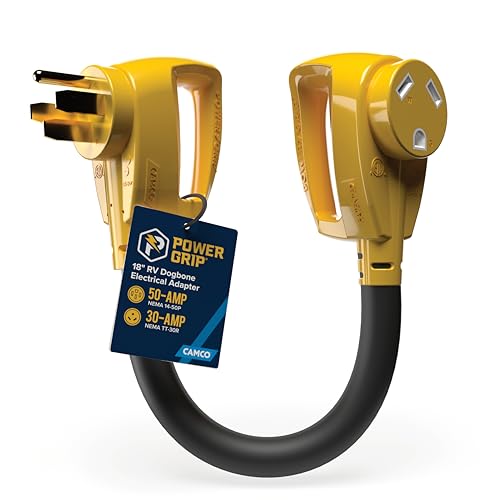
Camco PowerGrip Dogbone, 50A Male to 30A Female
$16.11Lets a 30A rig plug into a 50A pedestal. Does not increase the rig above its 30A, 3,600 watt limit.
Best for: A 30A rig at a 50A pedestal.
Check price on Amazon
ELEGRP 30A to 50A Dogbone Adapter
$19.19Lets a 50A rig plug into a 30A pedestal. The rig is limited to 30A total, roughly a quarter of its normal 12,000 watt capacity, while connected.
Best for: A 50A rig at a 30A pedestal, with loads managed accordingly.
Check price on AmazonFrequently asked questions
- Why is 50A shore power more than double 30A if the amperage numbers only differ by 67 percent?
- Because 30A service is a single 120V leg while 50A service is two separate 120V legs. Total power is voltage times amperage times number of legs, so 50A service is 120V x 50A x 2, or 12,000 watts, against 30A service at 120V x 30A x 1, or 3,600 watts. That works out to more than three times the power, not the smaller increase the amperage figures alone suggest.
- Does a 50A to 30A dogbone adapter let a 50A rig draw 50 amps from a 30A pedestal?
- No. The adapter only changes the physical plug shape. The pedestal itself is still wired and breakered for 30A, so a 50A rig plugged in through this adapter is limited to 30A total, roughly a quarter of its normal 12,000 watt capacity, for as long as it stays connected there.
- Can I run two air conditioners on a 30A shore power connection?
- Generally not at the same time. Two air conditioners together typically exceed the 3,600 watts available on a 30A service once startup draw is included, which is one of the main practical differences that pushes larger rigs with dual AC units to 50A service instead.
- What does an EMS protect against that a basic surge protector does not?
- A basic surge protector only clamps voltage spikes. An EMS additionally disconnects the RV on low voltage, high voltage, open ground and reverse polarity conditions, all of which are common at older or poorly maintained campground pedestals and can damage RV electronics or appliances without a spike ever occurring.
- Why does a 50A EMS need to monitor two legs instead of one?
- Because 50A service is two independent 120V legs, and a fault, a dropped leg, or reversed polarity on one leg can exist without affecting the other. An EMS that only monitors a single leg on a 50A connection would miss any problem confined to the leg it is not watching.
- Is 50A service just a faster-charging version of 30A?
- No, both services charge the RV’s onboard converter at whatever rate the converter itself is rated for, since the converter, not the shore power service, sets charging speed. The difference between 30A and 50A service is total available power for running appliances and air conditioners simultaneously, not battery charging speed.
A word on safety. Never assume an adapter increases the power available to your rig. The lower-rated side of any adapter sets the real limit, and loads should always be sized to that lower number while the adapter is in use.