Batteries
How Long Will a 200Ah Battery Run a 10 Amp Load?
Researched from published standards and manufacturer specifications. Updated .
Quick answer
Run time is usable amp-hours divided by the load. The trap is the word usable: nameplate capacity is not what you get, and the gap between the two is much larger on lead-acid than on lithium.
There is a second effect on lead-acid called the Peukert relationship, which says a battery delivers less total capacity the faster you discharge it. Lithium is close enough to linear that applying the correction would suggest a precision that is not really there, so it is left off. Run your own numbers on the run time calculator.
How long does a 200Ah battery last at 10 amps?
| Chemistry | Usable capacity | Run time | Peukert applied |
|---|---|---|---|
| LiFePO4 at 80 percent | 160 Ah | 16 h | No |
| Lead-acid at 50 percent | 100 Ah | 10 h | Yes |
Convention Source: Depth of discharge is a planning convention. The Peukert exponent of 1.25 is a typical published lead-acid figure..
How does run time change with the load?
Same 200Ah bank, different loads. Note how lead-acid falls away faster than a straight division would predict as the current rises.
| Load | LiFePO4 run time | Lead-acid run time | Typical load of this size |
|---|---|---|---|
| 1 A | 160 h | 177.8 h | LED lighting, phone charging |
| 2 A | 80 h | 74.8 h | Roof vent fan |
| 5 A | 32 h | 23.8 h | 12V compressor fridge |
| 10 A | 16 h | 10 h | Fridge plus lights plus fan |
| 20 A | 8 h | 4.2 h | Small inverter load |
| 40 A | 4 h | 1.8 h | Microwave or induction burner |
Convention
What does this mean in days off grid?
A 10 amp load running continuously uses 240Ah a day, which almost nothing in an RV actually does. Real loads cycle. A compressor fridge drawing 10 amps while running might only run a third of the time, making the real daily figure closer to 80Ah.
That is why a measured daily total beats a running-watts guess every time. Build yours up on the daily energy budget calculator, then size the bank with the battery bank page for that daily load.
How do you know what is actually left in the bank?
On lead-acid, resting voltage is a reasonable guide, provided the battery has been off charge and off load for several hours. On LiFePO4 it is nearly useless: the discharge curve is so flat that the pack sits around 13.1 volts from roughly 20 percent to 90 percent state of charge.
This is exactly what a shunt is for. It counts every amp-hour in and out and reports a real state of charge rather than inferring one from voltage. On a lithium bank you plan to boondock on, it is not optional equipment.

Victron SmartShunt 500A Battery Monitor
Price varies, check the listingA shunt counts amp-hours in and out, which is the only accurate way to read lithium state of charge. Voltage alone cannot do it on a flat discharge curve.
Best for: Any lithium bank you plan to boondock on.
Check price on Amazon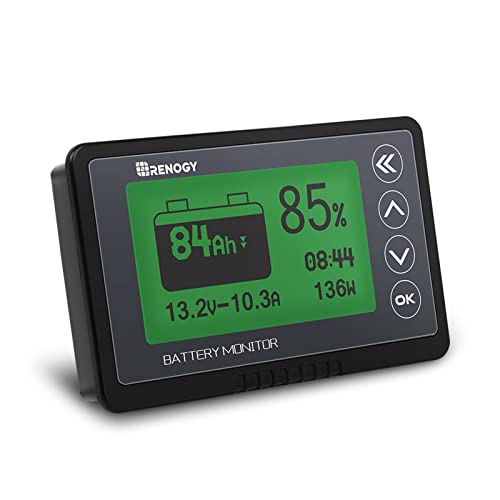
Renogy 500A Battery Monitor with Shunt
$63.10Includes a wired display head, so you get a reading without needing a phone in your hand.
Best for: A panel-mounted readout.
Check price on AmazonBatteries and monitoring for a 200Ah bank

Super Empower 12V 100Ah LiFePO4, Group 24
$182.99A Group 24 case drops into most existing lead-acid battery boxes without modification, and the BMS stops charging below freezing.
Best for: A first lithium conversion in a travel trailer that already has a Group 24 tray.
Check price on Amazon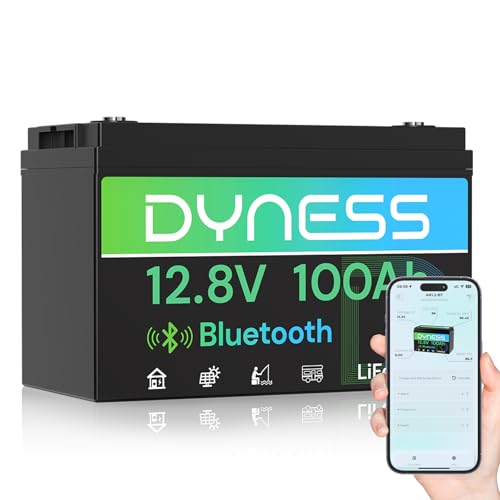
Dyness 12V 100Ah LiFePO4 with Bluetooth
$199.98Bluetooth reporting of pack voltage and state of charge means you can check the bank without adding a separate shunt monitor.
Best for: Owners who want pack data without wiring a shunt on day one.
Check price on Amazon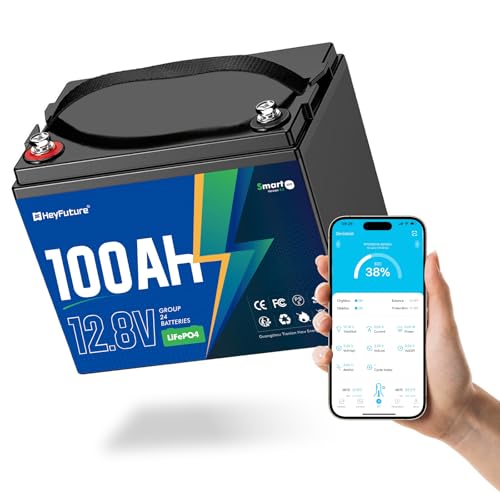
HeyFuture 12V 100Ah LiFePO4 with Bluetooth
$159.99One of the lower-cost Bluetooth packs with a published 100A BMS rating, which is the figure that limits inverter size.
Best for: A single-battery bank feeding a 1000W inverter.
Check price on Amazon
Vemdia 12V 100Ah LiFePO4, Group 31
$153.99A Group 31 case with a 100A BMS, which is the common size for a purpose-built RV battery compartment.
Best for: Replacing a single Group 31 lead-acid battery.
Check price on AmazonFrequently asked questions
- How long will a 200Ah battery run a 10 amp load?
- About 16 hours for LiFePO4 planned to 80 percent depth of discharge, or about 10 hours for lead-acid planned to 50 percent. The lithium figure is higher for two reasons: more of the nameplate capacity is usable, and lithium does not lose effective capacity at higher discharge rates the way lead-acid does.
- Why does lead-acid last less than half as long?
- Two effects stack. First, only about 50 percent of a lead-acid battery is usable against roughly 80 percent for LiFePO4, so the starting point is lower. Second, the Peukert relationship means lead-acid delivers less total capacity as the discharge rate rises, so a heavy load costs proportionally more than a light one. Together they account for the gap.
- Can I discharge a lithium battery fully?
- Most LiFePO4 packs are rated for full depth of discharge and the BMS will disconnect before damage occurs. Planning at 80 percent is still the more conservative approach, because it leaves reserve for a miscalculation and reduces the stress at the bottom of the curve. Check what your specific battery manufacturer publishes for cycle life against depth of discharge.
- Does temperature affect run time?
- Considerably, and more so on lead-acid. A cold lead-acid battery can deliver substantially less than its rated capacity, so a bank that lasts through a summer night may fall short on a cold one. LiFePO4 holds capacity better in the cold but must not be charged below freezing, which is a charging restriction rather than a discharge one.
Lithium safety. A LiFePO4 bank needs a charger with a genuine lithium profile, and that means the converter, the solar controller and any DC-DC charger all have to be set correctly. A stock lead-acid converter will never bring a lithium pack to full. Charging a lithium battery below freezing damages the cells permanently, so the pack needs either a low temperature charge cutoff in its BMS or a self-heating design if you camp in the cold.