Reviews
Renogy Rover 40A MPPT Review: Sizing It Right and When to Skip It
Researched from published standards and manufacturer specifications. Updated .
Quick answer
A 40A MPPT controller like the Renogy Rover exists to solve two problems at once: converting a solar panel's variable voltage into the current a battery can actually accept, and applying the correct charge profile for whatever chemistry sits behind it. The Rover's headline feature for a lithium conversion is not its amperage, it is that its absorption and float voltages are user-settable rather than fixed, which is what lets an owner dial in a genuine LiFePO4 profile instead of accepting whatever preset the controller shipped with for lead-acid.
Amperage still sets a hard ceiling, though. A 40A controller on a 12V system caps out at roughly 480 to 520 watts of panel before the array exceeds what the controller can safely pass through, and that ceiling matters more to most buyers than any feature list, since exceeding it is the most common sizing mistake with this class of controller.
How much solar can a 40A controller actually carry?
On a 12V system, a 40A MPPT controller is generally rated for roughly 480 to 520 watts of panel, since rated amperage times system voltage sets the practical ceiling regardless of how the panels are wired. A single 200 watt panel, two 200 to 250 watt panels, or three smaller panels wired to stay under that wattage all fit comfortably. Pushing much past 520 watts on a 12V bank means either stepping up to a higher-amperage controller or moving the array to a 24V system, which this same controller also supports through its auto-detecting 12V/24V input.
Renogy Rover 40A MPPT vs the PWM alternative
The comparison below uses published specifications and current catalog pricing. Full specifications for the Rover itself are on its dedicated specs page linked below.
| Factor | Renogy Rover 40A MPPT | Renogy Wanderer Li 30A PWM |
|---|---|---|
| Controller type | MPPT | PWM |
| Amp rating | 40A | 30A |
| System voltage | 12V/24V auto | 12V |
| Charge profile | User-settable, including lithium | Fixed lithium profile included |
| Typical array it fits well | 400 to 520W on 12V, multiple panels | One panel up to roughly 400W on 12V |
| Listed price | $194.67 | $32.99 |
Published standard Source: Manufacturer-published specifications and current catalog listings in this repository.. Actual harvest gain from MPPT over PWM depends on panel voltage and temperature and is not a fixed figure either manufacturer publishes.
Who should not buy it?
Anyone running a single 100 watt panel, wired close to battery voltage, does not need this controller. In that exact case an MPPT controller's efficiency advantage over PWM shrinks close to zero, because MPPT gains come from converting excess panel voltage into extra current, and a small panel matched close to battery voltage has little excess to convert. The Renogy Wanderer Li 30A, a PWM controller with a genuine lithium profile built in, covers that setup for around a sixth of the Rover's price and leaves little on the table in practice. The Rover earns its price difference once a second panel gets added, or once the array's open-circuit voltage runs well above battery voltage, both common on RV roof arrays larger than one small panel.
What it does not include
The Rover does not include panels, mounting hardware, wiring or a battery. It is the charge controller alone, sold as the piece that sits between whatever panels are chosen and the battery bank they charge. It also does not include a separate remote display in this listing; the LCD is built into the controller body itself, so mounting it somewhere visible, rather than tucked inside a compartment, matters if checking status at a glance is a priority. Owners who want Bluetooth monitoring without opening the compartment should compare the Renogy Rover BT 40A, which adds that feature at a modest premium over this model. It also does not include the fuse, breaker or the correctly sized wiring between the panels, the controller and the battery, all of which have to be sized to the array's actual current, not just to the controller's 40A rating, since undersized wiring ahead of the controller creates the same voltage-drop and heat problems on the solar side that undersized wiring creates anywhere else in a 12V system.
What owners report
Owners consistently report the LCD screen is readable and that switching the battery type setting between the presets, or into the fully custom voltage fields, is straightforward once the manual's parameter table is in hand. A recurring theme in verified owner reviews is that the default lithium preset works fine for many packs, but owners running a battery with a specific manufacturer-recommended absorption voltage get better long-term charging by entering that exact figure manually rather than trusting the generic lithium preset. Some owners report the internal fan is audible under heavy charging load on hot days, normal for an actively cooled MPPT controller of this class rather than a sign of a problem, though it is worth planning the mounting location with that noise in mind if the controller sits near a sleeping area.
The honest alternatives
The Renogy Rover BT 40A is the same core controller with Bluetooth added, worth the small premium for anyone who wants to confirm actual harvest against sizing assumptions without opening a compartment. The ECO-WORTHY 40A MPPT and the Dyness 40A MPPT both undercut the Rover on price while covering the same 400 to 520 watt range, without Renogy's longer track record of published documentation and firmware support. For a single small panel where MPPT's advantage genuinely disappears, the Renogy Wanderer Li 30A is the honest cheaper choice, not a downgrade in that specific setup.
Confirm the charge profile before connecting a lithium battery. Leaving any MPPT controller on a lead-acid preset will chronically undercharge a LiFePO4 bank. Set the absorption and float voltages to the battery manufacturer's published figures, or select the correct lithium preset, before relying on the controller to fully charge the pack.
Which charge controller to buy
Buy MPPT once the array grows past one small panel or the panel voltage runs well above battery voltage. Buy PWM only for that one small, closely matched panel, where the price gap buys little practical benefit.

Renogy Rover 40A MPPT with Bluetooth
$197.40Same 40A MPPT core plus wireless monitoring, so harvest can be checked against sizing assumptions without opening the compartment.
Best for: Verifying an array is producing what it was sized for.
Check price on Amazon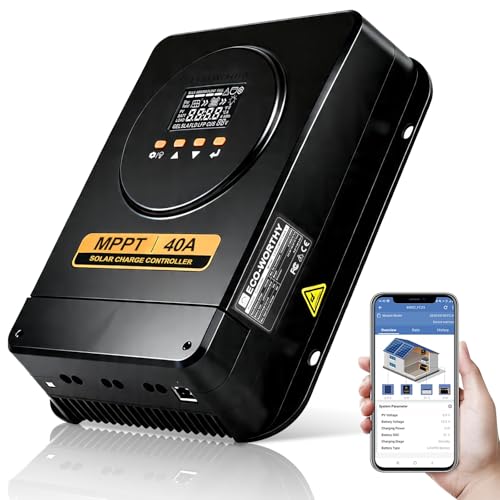
ECO-WORTHY 40A MPPT with Bluetooth
$135.99Covers the same 400 to 520 watt range at a lower listed price, with Bluetooth included.
Best for: A 400W to 500W roof array on 12V.
Check price on Amazon
Renogy Wanderer Li 30A PWM Controller
$32.99A genuine lithium profile in a PWM controller, for the one-panel setup where MPPT gains are minimal.
Best for: A small lithium bank behind one or two panels.
Check price on AmazonFrequently asked questions
- How many watts of solar can the Renogy Rover 40A MPPT handle?
- Roughly 480 to 520 watts on a 12V system, since the 40A rating times system voltage sets the practical ceiling. On a 24V system, which the controller also auto-detects, that ceiling roughly doubles in watts for the same amperage, though most single-battery 12V RV systems stay on 12V.
- Does the Rover work with a single 100 watt panel?
- It works, but it does not need to be an MPPT controller for a setup that small. A single 100 watt panel wired close to battery voltage sees little benefit from MPPT over PWM, so the Renogy Wanderer Li 30A PWM controller covers that exact case for a fraction of the price.
- Can I set a custom lithium charge profile on this controller?
- Yes, the Rover's absorption, float and other charge parameters are user-settable rather than fixed, which lets an owner enter the exact voltages a specific LiFePO4 pack's manufacturer recommends instead of relying on a generic preset.
- What is the difference between the Rover 40A and the Rover BT 40A?
- They share the same 40A MPPT core and charge profile settings. The BT version adds Bluetooth so harvest and settings can be checked from a phone without opening the compartment where the controller is mounted, at a modest price premium over the standard Rover.
- Does this controller include a remote display?
- No separate remote display is included in this listing; the LCD is built into the controller's own body, so mounting location affects how easily it can be read day to day. Anyone planning to tuck the controller inside a compartment where the screen will not be visible should weigh the Bluetooth-equipped Rover BT version instead, since that trades a wall-mounted screen for a phone-based readout that works regardless of where the controller physically sits.
- Is MPPT always worth the extra cost over PWM?
- Not always. The gain is largest with multiple panels, higher panel voltage, or cold weather, and shrinks close to zero on one small panel matched near battery voltage. Check the planned array size and panel voltage before assuming MPPT is worth its price premium over a PWM controller.
Researched from published specifications and verified owner reviews, not in-person testing. Size the array to the controller's amperage at your actual system voltage before buying panels, and confirm the charge profile matches your battery chemistry once installed.