Reference
DC-DC Charger Sizing Chart by Alternator Rating
Researched from published standards and manufacturer specifications. Updated .
Quick answer
A DC-DC charger should draw no more than a share of the alternator's rated output, commonly 40 percent as a convention, so the alternator still serves the vehicle and stays within its thermal limit. A 130A alternator at 40 percent gives 52A available, which points to a 50A DC-DC charger. Lithium accepts current almost without limit, which is exactly why it must never connect to an alternator directly; the DC-DC charger is the current limit, not an optional upgrade.
An alternator is built to serve the vehicle's own electrical system first, with margin left over for accessories. Sending too much of its output to a house battery risks overheating the alternator or starving the vehicle's own systems, which is why this site applies a 30 to 50 percent share convention rather than trying to use the full rated output. That share is not a figure published by an alternator manufacturer for this specific purpose; it is a commonly used planning convention, and the tables below label it as such at every point.
The reason a DC-DC charger exists at all, rather than a simple wire and isolator, is that LiFePO4 accepts charge current almost without limit and will pull as much as an alternator can supply through a direct connection, which is well beyond what most alternators are built to survive continuously. The DC-DC charger is the current limit and the lithium-aware charge profile in one device, and its rated amperage is the number that actually protects the alternator.
DC-DC charger size by alternator rating and share available
Buy size rounds down to the largest standard DC-DC charger amperage that does not exceed the current available at each share convention. A lower share is more conservative for an older alternator or one without extra cooling; a higher share assumes upgraded wiring and cooling.
| Alternator rating | 30% share (conservative) | 40% share (typical) | 50% share (upgraded cooling) |
|---|---|---|---|
| 80A | 20A available: 24A, buy 20A | 40A available: 32A, buy 30A | 50A available: 40A, buy 40A |
| 100A | buy 30A (30A avail) | buy 40A (40A avail) | buy 50A (50A avail) |
| 130A | buy 30A (39A avail) | buy 50A (52A avail) | buy 60A (65A avail) |
| 150A | buy 40A (45A avail) | buy 60A (60A avail) | buy 60A (75A avail) |
| 180A | buy 50A (54A avail) | buy 60A (72A avail) | buy 60A (90A avail) |
| 220A | buy 60A (66A avail) | buy 60A (88A avail) | buy 60A (110A avail) |
Convention Source: The 30, 40 and 50 percent share figures are planning conventions used by this site's DC-DC charger calculator, not manufacturer specifications for a specific alternator. The first row's 80A entry is written out in full to show the calculation; the remaining rows give the result directly. Standard DC-DC charger sizes used here are 20A, 30A, 40A, 50A and 60A.
Reverse lookup: alternator rating needed for a target charger size
Flip the question around: for a specific DC-DC charger amperage, what alternator rating actually supports it at each share convention. A 40A charger, for example, needs at least a 133A alternator at the conservative 30 percent share, or an 80A alternator at the more generous 50 percent share.
| Charger size | At 30% share | At 40% share | At 50% share |
|---|---|---|---|
| 20A | 67A | 50A | 40A |
| 30A | 100A | 75A | 60A |
| 40A | 133A | 100A | 80A |
| 50A | 167A | 125A | 100A |
| 60A | 200A | 150A | 120A |
Convention Source: Charger amps / share convention, the inverse of the table above.
Daily energy added by drive time
A DC-DC charger only adds energy while the engine is running, so drive time is the real constraint on how much a lithium bank can recover on the road. This assumes a typical 13.6V absorption charge voltage as a convention, since actual voltage varies through the charge cycle.
| Charger size | 1 hour | 2 hours | 4 hours | 6 hours |
|---|---|---|---|---|
| 20A | 272Wh | 544Wh | 1,088Wh | 1,632Wh |
| 30A | 408Wh | 816Wh | 1,632Wh | 2,448Wh |
| 40A | 544Wh | 1,088Wh | 2,176Wh | 3,264Wh |
| 50A | 680Wh | 1,360Wh | 2,720Wh | 4,080Wh |
Convention Source: Charger amps x hours x 13.6V, a typical absorption charge voltage convention used by this site's DC-DC charger calculator.
Checking your own alternator before picking a number off this chart
The tables above use alternator nameplate ratings in round numbers, but the figure that actually matters is what your specific vehicle's alternator is rated for, which is usually printed on the alternator itself or found in the vehicle's service documentation rather than assumed from engine size or model year. Two trucks that look identical from the outside can carry different alternator options from the factory, and an aftermarket high-output alternator swap changes every number in this chart for that specific vehicle. Confirm the actual rating before committing to a DC-DC charger size, since undersizing the charger just charges slowly, but assuming a higher alternator rating than what is actually installed risks exceeding the conservative share this page is built around.
What if you are not charging from an alternator at all?
A DC-DC charger solves alternator charging specifically. If the goal is instead a maintenance charger for a battery sitting on shore power, or a way to top off the bank between trips without running the engine, that is a different device entirely: a 20A AC-to-DC charger such as the Power Queen or DCHOUSE units below plugs into a wall outlet or the pedestal and charges the bank directly, with no alternator or DC-DC current limiting involved.

Power Queen 12V 20A LiFePO4 Charger
$79.99A dedicated lithium profile rather than a lead-acid charger with a lithium mode bolted on.
Best for: Off-season top-ups.
Check price on Amazon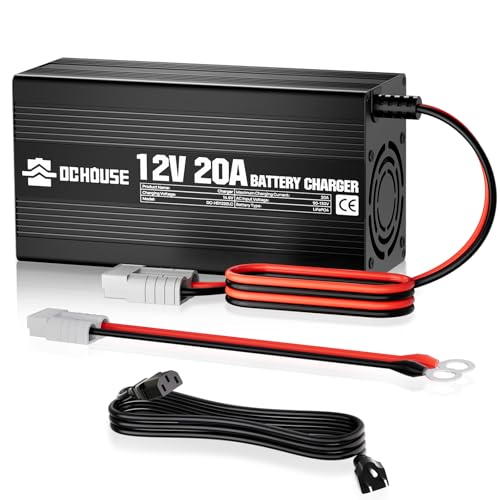
DC HOUSE 12V 20A Lithium Charger
$67.99Ships with a quick-connect lead, which makes off-rig charging a one-plug job rather than a clamp job.
Best for: A battery stored off the rig over winter.
Check price on AmazonNever wire a lithium house bank directly to a vehicle alternator through a plain isolator or VSR. LiFePO4's low internal resistance lets it draw sustained high current an alternator was not built for. A DC-DC charger is not an optional upgrade for a lithium bank charged from the engine; it is the current limit that keeps the alternator alive.
DC-DC chargers sized to this chart

Renogy 40A DC-DC Battery Charger
$186.99Matches a 130A alternator at the more conservative 30 percent share, or a 100A alternator at 40 percent.
Best for: Charging from the tow vehicle or chassis engine.
Check price on Amazon
LiTime 12V 40A DC-DC Charger with MPPT
$209.99Combines the same 40A alternator charging with a built-in solar MPPT input, useful when panel and alternator charging need to share one controller.
Best for: A build with both solar and alternator charging.
Check price on AmazonFrequently asked questions
- Why can't a lithium battery just wire straight to the alternator like a lead-acid battery used to?
- Lead-acid's higher internal resistance naturally limits how much current it pulls from an alternator even on a direct connection. LiFePO4 has much lower internal resistance and will accept sustained high current, well beyond what most alternators are built to supply continuously without overheating. A DC-DC charger sits between the two specifically to cap the current at a safe level and apply a genuine lithium charge profile.
- Where does the 40 percent alternator share figure come from?
- It is a commonly used planning convention rather than a figure published by an alternator manufacturer for house battery charging specifically. It leaves the majority of the alternator's rated output for the vehicle's own systems and for margin under real driving conditions, such as headlights, climate control, and other accessories running at the same time as the DC-DC charger.
- Can I use a higher alternator share if I upgrade the wiring and add a fan?
- Some installers do push toward 50 percent with upgraded cooling and heavier alternator-to-charger wiring, and that is reflected as the higher end of this page's convention range. This remains a judgment call rather than a manufacturer-published limit, so err conservative unless you have specifically verified your alternator's duty cycle rating and cooling capacity for sustained higher output.
- How much energy can I actually add to my battery on a day of driving?
- Multiply your DC-DC charger's amperage by the hours you expect to drive and by roughly 13.6V, a typical absorption charge voltage convention. A 40A charger over 4 hours of driving adds a little over 2,000Wh, which is a meaningful daily contribution for many rigs but rarely the entire daily budget on its own without solar or shore power alongside it.
- What happens if my alternator can't spare even a 20A DC-DC charger?
- That means the alternator's rated output is too small to safely support even the smallest common DC-DC charger at the site's conservative share convention. In that situation, charge the house bank from solar or shore power instead, or address the alternator itself, since forcing a DC-DC charger onto a marginal alternator risks the overheating and premature failure the current limit was meant to prevent.
- Is a DC-DC charger the same thing as a battery isolator?
- No. A plain isolator or VSR just connects two batteries together when the engine is running, with no current limiting and no charge profile control, which is fine for two lead-acid batteries of similar chemistry but unsafe for a lithium house bank on a vehicle alternator. A DC-DC charger actively limits current and applies a charge profile matched to the house battery's chemistry, which is what protects both the alternator and the battery.
Start from the alternator's rated output, not the charger's amperage. Use the share convention that matches your wiring and cooling, then check the reverse table if you already own a specific charger and want to know whether your alternator actually supports it.