Guides
How Load Shedding and Energy Management Work in an RV
Researched from published standards and manufacturer specifications. Updated .
Quick answer
Load shedding means the system drops a low-priority load automatically rather than letting the whole pedestal or generator connection trip. In practice: switch the water heater and the fridge to propane mode to free well over a kilowatt of electric capacity, sequence a microwave against an air conditioner rather than running both at once, and fit a soft starter so an air conditioner's startup surge stops tripping a breaker that the running load would otherwise fit inside easily.
Energy management in an RV is really a capacity problem: shore power, a generator, or an inverter all have a hard ceiling, and the goal is keeping total load under that ceiling without giving up the appliances you actually want to run. Load shedding is the automated version of that discipline, where a system drops a lower-priority circuit rather than tripping everything, but the same principle works manually with nothing more than habit and a soft starter.
This guide covers what load shedding actually means in an RV context, the specific appliance swaps and sequencing habits that free up real capacity, and how a soft starter changes what a modest generator or a tight shore power connection can actually support.
What is load shedding, and why does an RV need it?
Load shedding is dropping a lower-priority electrical load automatically when total demand approaches a system's limit, rather than letting the limit be exceeded and tripping a breaker or overloading a generator. An RV needs this because its power sources, whether a 30A pedestal, a portable generator, or an inverter running off the battery bank, all have a fixed ceiling that is easy to exceed by simply running too many appliances at once. Some RVs have a built-in energy management system that sheds load automatically; in most rigs, the same result comes from manual habits and equipment choices instead.
How much capacity does switching to propane actually free up?
A meaningful amount. RV electric water heater elements are commonly rated in the range of 1,400 to 1,500 watts, and a residential-style electric refrigerator's heating or defrost elements add a further few hundred watts when running on electric mode. Switching both to propane operation, where the appliance is available, removes that electric draw entirely rather than reducing it, which is often the single largest and easiest capacity gain available without touching any wiring. This matters most on a 30A service, where total available power is a fixed 3,600 watts, so freeing over a kilowatt from these two appliances alone meaningfully changes what else fits.
How do I sequence heavy loads so a breaker doesn't trip?
Avoid starting a second high-draw appliance while another is already running near its own peak, particularly a microwave against an air conditioner's compressor startup. Running the microwave, finishing, and then starting the air conditioner, or the reverse, keeps each appliance's startup surge from stacking on top of the other's running load at the same instant. This costs nothing beyond a moment's attention and is the most accessible form of load shedding available on a rig with no automated system at all.
Typical RV appliance loads used for load shedding decisions
These are commonly cited planning ranges for typical RV appliances, not measured figures for any specific unit. Check your own appliance's nameplate rating for the actual number that applies to your rig.
| Appliance | Typical running watts | Typical startup watts |
|---|---|---|
| Rooftop air conditioner (13,500 BTU class) | ~1,200 to 1,500W | ~1,800 to 3,500W depending on unit |
| Microwave | ~900 to 1,300W | Close to running watts, brief |
| Electric water heater element | ~1,400 to 1,500W | Close to running watts, no significant surge |
| Residential-style refrigerator (electric mode) | ~150 to 400W typical, higher at defrost | Modest compressor startup surge |
Convention Source: Commonly cited RV appliance wattage ranges used in electrical planning guidance. Exact figures vary by model; check the appliance's own nameplate for its specific rating.. Air conditioner startup watts vary widely by compressor design and are exactly what a soft starter is built to reduce.
How does a soft starter change what a generator or shore connection can support?
A rooftop air conditioner's compressor draws a brief, large surge of current at startup, often two to three times its running wattage, and that surge is frequently what trips a breaker or stalls a smaller generator, not the running load itself. A soft starter reduces that startup current sharply by ramping the compressor motor up gradually instead of switching it on at full current immediately. This does not change the air conditioner's running wattage once it is operating normally; it specifically targets the startup spike, which is why a soft starter can let an air conditioner run on a generator that would otherwise stall trying to start it, even though that same generator has enough continuous capacity for the running load.
If I only have a 30A pedestal, what should I drop first?
On a fixed 3,600 watt total, the order you cut load in matters as much as which loads you cut. This is a practical priority order based on typical wattage, not a measured result for a specific rig, and your own appliance nameplates take precedence over these ranges.
| Move | Approximate capacity freed | What it costs you |
|---|---|---|
| Switch water heater to propane | ~1,400 to 1,500W | None, if propane is already plumbed to it |
| Switch fridge to propane mode | ~150 to 400W | None on an absorption-style fridge with a propane mode |
| Delay the microwave until the AC is not starting | Avoids stacking startup surges | A few minutes of waiting |
| Add a soft starter to the air conditioner | Cuts startup surge, not running watts | One-time equipment cost |
| Turn off the second air conditioner entirely | ~1,200 to 1,500W | No cooling in that zone |
Convention Source: Commonly cited RV appliance wattage ranges used in electrical planning guidance, applied to the fixed 3,600 watt total of a 30A, 120V service per NEMA TT-30.. The first two moves cost nothing but propane availability and are almost always worth doing before considering which electric appliance to simply turn off.
Does load shedding replace the need to size wiring and breakers correctly?
No. Load shedding, whether automated or done by habit, manages which loads run at the same time; it does not change the ampacity the wiring and overcurrent devices in the system need to safely carry. A circuit still has to be fused and sized for the worst case current it could see, using standard sizing rules, regardless of how carefully loads are normally sequenced. Confirm your wiring with a wire gauge calculator and a fuse size calculator as the baseline, then use load shedding habits on top of correctly sized wiring, not as a substitute for it.
Does the same priority order apply on a 50A service?
Not in the same way, because a 50A service splits its capacity across two separate 120V legs rather than sharing one pool the way 30A does. The practical difference is that load shedding on a 50A rig is often more about balance between the two legs than about total capacity, since each leg individually carries roughly the same 3,600 to 6,000 watt range a 30A service works with on its own. If one leg is feeding both air conditioners while the other sits mostly idle, moving one air conditioner's circuit to the lighter leg, where the panel wiring allows it, solves a trip that switching to propane on the water heater would not, since the water heater might already be on the leg with spare capacity. Checking which appliances are wired to which leg, usually labeled on the breaker panel, is worth doing once so you know which lever actually helps before you are troubleshooting a trip in the moment.
When is an automated energy management system worth adding over manual habits?
Manual sequencing works fine for an owner who is present and paying attention every time they run heavy appliances. An automated system earns its cost when loads run unattended, such as an air conditioner cycling on its own thermostat while nobody is watching to avoid starting the microwave at the same moment, or in a rig with enough appliances that manually tracking every combination becomes impractical. For most single-air-conditioner rigs with a modest appliance list, a soft starter plus the propane swap and manual sequencing habits above covers the load management need without an automated system.
How does an inverter fit into a load-shedding plan?
An inverter adds a genuine ceiling of its own, separate from the shore power or generator connection feeding it, since it can only deliver its own rated continuous wattage plus whatever surge headroom it is built with. On battery power specifically, load shedding matters even more than on shore power, because there is no larger utility feed to fall back on if the battery bank sags under a combined load the inverter cannot deliver cleanly. Running a coffee maker and a hair dryer through the same inverter at the same time, for instance, can exceed a modest inverter's continuous rating even though either appliance alone would run fine, and unlike a breaker trip on shore power, an overloaded inverter can shut down entirely and cut power to everything it was running rather than just the one over-limit circuit. Size the inverter itself with an inverter sizing calculator against your real combined load, including the single largest startup surge you expect it to see, then apply the same sequencing habits used for shore power and generator loads to whatever runs through it.
Load shedding manages which loads run together; it does not replace correct fuse and wire sizing. Every circuit still needs to be sized and protected for the worst case current it could see, independent of how carefully loads are normally sequenced or shed.
What actually reduces peak load in practice
A soft starter addresses the startup spike specifically; it does not reduce the running wattage an appliance draws once it is up and operating. Pair it with the propane swap and sequencing habits below rather than expecting it to solve every capacity problem on its own.

Spartan Power SpartanStart Soft Start Kit
$189.00Rated to 20,000 BTU, which covers most common rooftop units, at a lower price than a full kit install.
Best for: A standard rooftop unit up to 20,000 BTU.
Check price on Amazon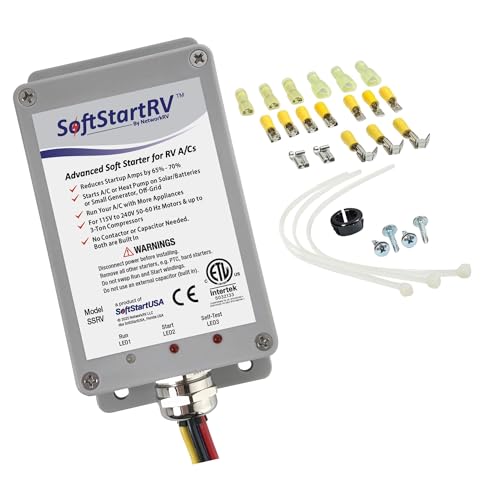
SoftStartRV Soft Start Kit
$295.00A widely documented soft start kit built specifically for RV rooftop air conditioners running on a smaller generator or an inverter.
Best for: Running air conditioning on a 2000W class generator.
Check price on Amazon
SoftStartUp Plug and Play RV A/C Soft Start
$595.00Plugs in ahead of the air conditioner rather than being wired inside the unit, which keeps the job out of the rooftop enclosure entirely.
Best for: Anyone unwilling to open a rooftop air conditioner.
Check price on AmazonFrequently asked questions
- What is the fastest way to free up electrical capacity without buying anything?
- Switch the water heater and, if equipped, the refrigerator to propane operation instead of electric, and avoid starting a microwave and an air conditioner at the same moment. Both are free habit changes that can free well over a kilowatt of capacity on a 30A service without any new equipment.
- Does a soft starter reduce how much electricity an air conditioner uses overall?
- No. A soft starter specifically reduces the brief startup current surge when the compressor first engages; it does not change the air conditioner's running wattage once it is operating normally. The benefit is avoiding a nuisance trip or a stalled generator at startup, not lowering overall energy consumption.
- Can I run a rooftop air conditioner on a small portable generator?
- It depends on the generator's rated capacity against the air conditioner's startup surge specifically, since the surge is often what a smaller generator cannot handle even though its continuous rating covers the running load. A soft starter is the standard fix for exactly this mismatch, letting a smaller generator start an air conditioner it otherwise could not.
- Is an automated energy management system necessary, or do manual habits work just as well?
- For an owner who is present and attentive every time heavy appliances run, manual sequencing habits work well and cost nothing. An automated system becomes more valuable when loads run unattended or when a rig has enough appliances that tracking every combination manually becomes impractical.
- Does load shedding mean my wiring can be sized smaller than normal?
- No. Wiring and overcurrent devices still need to be sized for the worst case current a circuit could see, using standard ampacity and fuse sizing rules, regardless of how loads are normally managed day to day. Load shedding manages behavior; it does not change what the physical wiring has to be rated to handle.
- How much startup surge does a soft starter typically remove?
- The reduction varies by the specific soft starter and compressor, and is not a single figure that applies universally, but the products in this category are specifically built to bring a compressor's startup current down close to its running current instead of the multiple-times spike an unmodified compressor draws. Check the specific soft starter's documentation for the reduction it publishes for your air conditioner's BTU class.
Load shedding is about managing peaks, not overall consumption. Freeing capacity by switching appliances to propane, sequencing heavy loads by hand, and cutting startup surge with a soft starter all target the moment demand is highest, which is almost always where a trip or a stall actually happens.