Power sourcing
Soft Starter vs Bigger Generator: Running RV AC Off Grid
Researched from published standards and manufacturer specifications. Updated .
Quick answer
A soft starter, priced around $189 to $595, cuts a rooftop air conditioner's compressor inrush enough that one manufacturer's plug-and-play unit is rated to work with generators as small as 2,200W. Stepping up to a genuinely bigger generator instead can cost several hundred dollars more and adds real weight that has to be lifted at every stop.
A soft starter solves the exact moment an RV air conditioner is hardest on a generator: the split second the compressor motor first energizes and draws several times its running current. Cutting that inrush spike is often enough to let the same air conditioner start and run on a generator one or two size classes smaller than the compressor's nameplate would otherwise demand, and it also stops the AC startup from tripping a campground pedestal breaker.
Buying a bigger generator solves the same problem from the other direction: enough surge capacity that the inrush never comes close to overwhelming it. That works, but it comes with a real cost curve. Generator weight climbs steeply as output rises, and a generator too heavy for one person to lift into the bay is a generator that quietly stops getting used.
What does a soft starter actually change about how the AC starts?
An air conditioner compressor is an induction motor, and induction motors draw far more current the instant they start than they do once spinning at speed. That inrush spike, not the running load, is what trips breakers and stalls small generators. A soft starter sits between the power source and the compressor and limits how fast current is allowed to ramp up at the moment of starting, spreading the same startup work over a longer, gentler curve instead of one sharp spike. The compressor still starts, and still reaches full running current within a couple of seconds, but the peak the generator or shore power circuit actually has to supply is dramatically reduced.
Soft starter against a bigger generator, side by side
| Soft starter | Bigger generator | |
|---|---|---|
| Typical price for the fix | $189 to $595 | Several hundred dollars more than the generator already owned |
| What it changes | Reduces compressor inrush at the AC itself | Adds enough surge capacity to absorb the existing inrush |
| Effect on generator weight carried | None, existing generator unchanged | Weight rises steeply with output class |
| Reduces pedestal breaker trips on shore power | Yes | Not applicable, shore power is not a generator |
| Makes AC usable on an inverter | Often, yes | No, a generator is a separate power source |
| Installation | Wired into the AC, or plug-in for the no-install option | None beyond normal generator setup |
Convention Source: Manufacturer specifications and listings for the products compared on this page. Actual generator size needed still depends on the specific air conditioner's compressor and any other loads running at the same time. A soft starter reduces the starting spike; it does not change the running wattage the compressor needs once started.
Why does generator weight rise so steeply with output?
A generator's output is tied directly to the size of its engine and alternator, and both scale up in weight faster than the wattage number on the box suggests. The Pulsar PGD40ISCO 4000W is marketed specifically as light enough for one person to move, which is a real selling point at the smaller end of the category. Step up to a unit like the WEN 6800W Dual Fuel, built to run a large rig or two air conditioners, and the added engine displacement, fuel capacity, and alternator mass add real, unavoidable weight. A generator nobody wants to lift out of the bay is a generator that stays there, which defeats the entire purpose of owning one.
Is running two smaller generators in parallel a third option?
It is, and it sidesteps the weight problem in its own way. Some inverter generators, including the ERAYAK 4500W Dual Fuel, are built parallel ready, meaning two identical units can be cabled together to combine their output for a heavier load, then split apart and carried separately the rest of the time. Two smaller generators paralleled for AC startup, then run singly for everyday charging and lighter loads, can end up lighter to carry piece by piece than one generator sized for the combined peak, at the cost of buying two units and a parallel cable kit instead of one machine.
A soft starter and generator paralleling are not mutually exclusive either. A rig that occasionally needs to run two air conditioners can pair two parallel-ready generators for that rare case while relying on a soft starter the rest of the time to keep a single smaller generator sufficient for one air conditioner alone.
Does a soft starter work on shore power too, or only on a generator?
Both. The same inrush spike that overwhelms a small generator is also what trips a 30A campground pedestal breaker when an air conditioner kicks on while other loads are already running. A soft starter reduces that spike regardless of whether the power source behind it is a generator, an inverter, or the campground pedestal itself, which is why it is worth installing even on a rig that always plugs into shore power and never runs a generator at all.
When is buying a bigger generator actually the better call?
A soft starter only addresses the starting spike of the equipment already on board. A rig that genuinely needs to run two air conditioners at once, a large inverter charging bank, and a residential fridge simultaneously has a running wattage problem, not just a starting inrush problem, and no soft starter changes the sustained load a generator has to supply once everything is up and running. In that case the honest answer is a generator sized for the real combined running load, such as the WEN 6800W Dual Fuel, with a soft starter added on top if starting either compressor still causes a momentary dip.
A carbon monoxide sensor on the generator itself is not optional. Generators like the WEN 6800W Dual Fuel and the Pulsar PGD40ISCO 4000W include a CO shutoff sensor. Never run any generator, soft starter installed or not, inside an enclosed space, and keep the exhaust pointed away from windows, vents, and neighboring rigs.
Soft starters and the generator alternative
Three soft starters and one generator sized to do the job without one. Compare the soft starter's price against the gap between the generator you already own and the one you would otherwise need to buy.
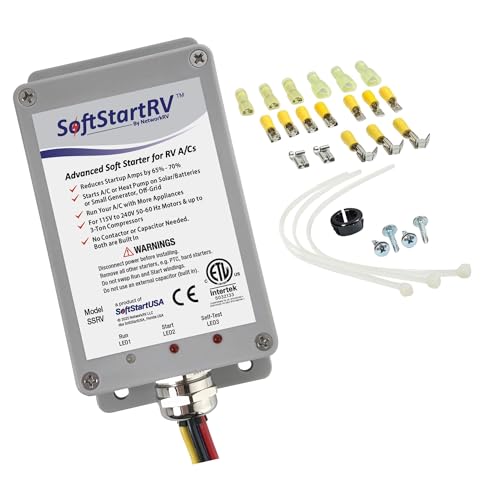
SoftStartRV Soft Start Kit
$295.00Wired into the air conditioner itself, cutting compressor inrush so the unit starts on a smaller generator or an inverter.
Best for: Running air conditioning on a 2000W class generator.
Check price on Amazon
Spartan Power SpartanStart Soft Start Kit
$189.00Rated up to 20,000 BTU, which covers the common 13,500 and 15,000 BTU rooftop units, at the lowest price in this comparison.
Best for: A standard rooftop unit up to 20,000 BTU.
Check price on Amazon
SoftStartUp Plug and Play RV A/C Soft Start
$595.00Plugs in ahead of the air conditioner rather than being wired into it, and the manufacturer lists it as compatible with generators as small as 2,200W.
Best for: Anyone unwilling to open a rooftop air conditioner.
Check price on Amazon
WEN 56477i 4800W RV-Ready Inverter Generator
$634.99An RV-ready inverter generator with a TT-30R outlet, sized to run one air conditioner without a soft starter, at a materially higher price and weight than any soft starter here.
Best for: A 30A rig that needs to run one air conditioner off grid.
Check price on AmazonFrequently asked questions
- Will a soft starter let my RV air conditioner run on any small generator?
- Not any generator, but it substantially widens what will work. A soft starter cuts the compressor's starting inrush, which is usually the reason a small generator trips or stalls, but the compressor still needs its full running wattage once started. Check the generator's continuous running watts against the air conditioner's running load, not just the starting load, before assuming any small unit will work.
- Is a soft starter cheaper than buying a bigger generator?
- In most cases, yes, by a wide margin. A soft starter runs roughly $189 to $595 depending on the model, while stepping up a full generator size class to handle the same starting spike typically costs several hundred dollars more on top of the price of a generator you may already own and would be replacing.
- Does a soft starter reduce how much power my AC uses overall?
- No. It reduces the brief starting current spike, not the steady running wattage the compressor draws once it is up to speed. Total energy used to run the air conditioner for an hour is essentially unchanged; what changes is the peak demand at the single moment the compressor kicks on.
- Can I install a soft starter myself, or does it need a technician?
- Some soft starters wire directly into the air conditioner's control board and are a more involved DIY project or a job for an RV technician. Plug-and-play models install ahead of the air conditioner with no wiring into the unit itself, trading a slightly higher price for avoiding that step. Check the specific product's installation method before buying if you want to avoid opening the rooftop unit.
- Why does a bigger generator weigh so much more than a small one?
- Output capacity scales with engine displacement, alternator size, and fuel capacity, all of which add mass faster than the wattage rating alone suggests. A generator marketed as light enough for one person to carry sits at the small end of the category; a generator built to run two air conditioners or a large rig carries meaningfully more engine and alternator to do it.
- Do soft starters work on campground shore power, not just generators?
- Yes. The same compressor inrush that stalls a small generator can also trip a 30A pedestal breaker, especially if other loads are already running. A soft starter reduces that spike regardless of whether the power source is a generator, shore power, or an inverter, so it is worth considering even on a rig that rarely runs a generator at all.
Size the generator for the running load, and let the soft starter handle the spike. A soft starter fixes a starting problem; it does not replace a generator that is genuinely too small for the total wattage running at once.