Systems
RV Converter vs Inverter/Charger: Which One Do You Need?
Researched from published standards and manufacturer specifications. Updated .
Quick answer
A converter only turns shore power AC into 12V DC to charge the battery. An inverter/charger does that plus inverts battery DC back to 120V AC and includes an automatic transfer switch, for roughly $250 to $1,200 versus $65 to $250 for a converter alone. Most rigs only need a converter with a lithium-compatible charge profile, not a full inverter/charger.
These two boxes get confused constantly because they sit in the same cabinet and both touch the battery bank, but they do opposite jobs. A converter is a one-way street: it takes 120V AC from shore power or a generator and turns it into 12V DC to charge the battery and run the DC panel. It cannot push power the other direction. An inverter/charger does both directions in one box, it charges from shore power like a converter and it inverts battery power back into 120V AC when you unplug, with a transfer switch built in that flips automatically between the two.
The decision that actually matters is not which box sounds more advanced. It is whether you need AC power when the rig is unplugged, and whether your current converter can charge the battery chemistry you actually have. Get those two questions right and the rest of this comparison is just picking a part number.
Do I need an inverter/charger, or can I keep my converter?
Ask one question first: when the rig is unplugged, do you need 120V AC power for anything, a residential fridge, a microwave, a CPAP without a battery pack, power tools? If the answer is no, an inverter/charger is buying you a feature you will not use. Keep the converter, make sure its charge profile matches your battery chemistry, and spend the difference on battery capacity or solar instead. If the answer is yes, you need inversion somewhere in the system, either as a standalone inverter added next to the existing converter or as a combined inverter/charger that replaces both.
A common real-world case is a lithium conversion done purely for longer boondocking on lights, the water pump, and a 12V compressor fridge, with no plan to ever run AC appliances off battery. That rig needs exactly one thing: a converter with a genuine lithium charge profile. Buying a full inverter/charger for that use case adds hundreds of dollars and an AC-side installation for a capability that never gets used, which is why the question about actual AC needs has to come before the question about which box to buy.
Converter vs inverter/charger, side by side
The feature list is short, but each line item changes what the box can and cannot do for you. A converter fails at exactly one thing an inverter/charger does not: it cannot make AC power when you are unplugged.
| Feature | Converter | Inverter/charger |
|---|---|---|
| Charges battery from shore power | Yes | Yes |
| Inverts battery DC to 120V AC | No | Yes |
| Built-in automatic transfer switch | No | Yes, switches source automatically |
| Lithium-compatible charge profile available | Only on lithium-specific models | Yes, on most current models |
| Typical price band in this catalog | $65 to $250 | $260 to $1,220 |
| Replaces a separate inverter and transfer switch | No | Yes |
Convention Source: Manufacturer spec sheets and listed pricing for the converter and inverter/charger products referenced on this page..
The lithium charging trap that catches converter-only rigs
A converter built around a lead-acid charge curve will never bring a LiFePO4 bank to full. Lead-acid absorption voltage sits lower than what lithium wants, and a lead-acid converter often floats early, leaving the lithium bank chronically undercharged even though the converter thinks the job is done. This is the single most common mistake after a lithium conversion, and it has nothing to do with whether you also want an inverter. Fixing it only requires a converter, or an inverter/charger, with a genuine lithium profile.
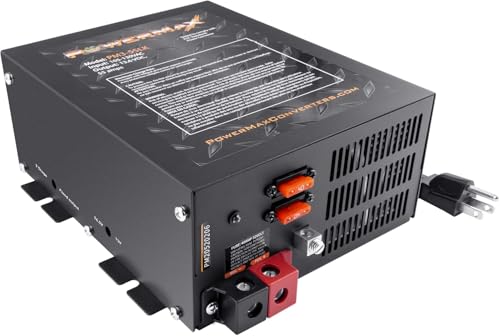
PowerMax PM3-55LK 55A Converter, Lithium
$133.00A lithium-specific charge profile. A stock lead-acid converter will never take a LiFePO4 bank to full, which is the single most common lithium conversion mistake.
Best for: The converter swap that has to happen with a lithium conversion.
Check price on Amazon
Renogy 2000W Pure Sine Inverter/Charger
$579.99One box that inverts from the bank and charges from shore power, with an internal transfer switch so the changeover is automatic.
Best for: Replacing a separate inverter and converter with one unit.
Check price on AmazonWhat an inverter/charger actually replaces
An inverter/charger is not an accessory bolted onto a converter, it is meant to replace the converter entirely along with a standalone inverter and the transfer switch that would otherwise sit between shore power and the panel. That consolidation is real value if you were going to buy all three parts anyway. It is a poor trade if your existing converter already works fine and all you actually wanted was occasional AC power, since a smaller standalone inverter wired to a fused feed from the battery does that job for a fraction of the price.
How to check whether your current converter is safe for lithium
Pull the model number off the converter's label and search the manufacturer's spec sheet or manual for its charge voltage curve, specifically the absorption and float voltages it targets. Compare those numbers against the battery manufacturer's recommended charge voltages for LiFePO4, which typically sit higher than a lead-acid float point. If the converter's documentation only lists a single lead-acid profile with no lithium mode mentioned, treat it as unsafe for full lithium charging even if the battery physically fits and appears to accept a charge, since an undercharged lithium bank can look like it is working while quietly losing usable capacity every cycle. Many current converters, including the models referenced on this page, publish a dedicated lithium setting or a switch to select it, and that documentation is the only reliable way to confirm compatibility rather than assuming a converter is fine because the battery connects and shows some charge current.
If the converter predates widespread lithium adoption, or its documentation is silent on chemistry, the safer and cheaper fix is usually replacing just the converter with a lithium-rated model rather than jumping straight to a full inverter/charger, unless you also need the inversion feature for other reasons.
Converter and inverter/charger picks by use case
Pick from the top row if the job is simply charging the battery correctly, including matching a lithium charge profile. Pick from the bottom row only if you actually need to run AC loads while unplugged, because that feature is most of what you are paying for.
PowerMax PM3-55LK 55A Converter, Lithium
$133.00A 55A deck-mount converter with a charge curve written for LiFePO4 instead of lead-acid, which is the part a converter-only rig is usually missing after a battery swap.
Best for: The converter swap that has to happen with a lithium conversion.
Check price on Amazon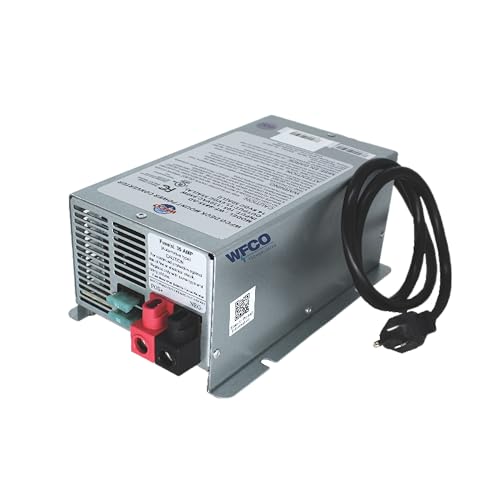
WFCO WF-9855-AD-CB 55A Converter/Charger
$248.99The genuine WFCO part most factory power centers already have a slot for, so it is often a drop-in swap rather than a rewiring job.
Best for: A direct drop-in replacement in a WFCO power center.
Check price on Amazon Renogy 2000W Pure Sine Inverter/Charger
$579.99One enclosure that charges from shore power, inverts from the bank, and switches between the two automatically, replacing a converter, a separate inverter, and a transfer switch.
Best for: Replacing a separate inverter and converter with one unit.
Check price on Amazon
Xantrex Freedom XC PRO 2000W Inverter/Charger
$1,216.32A 100A charger section inside the inverter/charger, which is the number that decides how quickly a large lithium bank refills from a generator or a pedestal.
Best for: Fast recharging a large lithium bank.
Check price on AmazonFrequently asked questions
- Can I add an inverter without replacing my existing converter?
- Yes. A standalone inverter wired to the battery bank through its own fuse works alongside an existing converter with no conflict, since the converter only ever sends power one direction and the inverter only ever sends it the other. This is usually cheaper than buying a combined inverter/charger if the current converter already charges the battery correctly.
- Will a stock converter charge a lithium battery to full?
- Only if it carries a lithium-specific charge profile. A converter built for lead-acid will often float the charge below what LiFePO4 needs to reach 100 percent, leaving the bank permanently undercharged. Check the converter's published charge voltage against the battery manufacturer's recommended absorption voltage before assuming it is compatible.
- What is the real difference between an inverter and an inverter/charger?
- A plain inverter only converts battery DC into 120V AC, it has no idea what shore power is doing. An inverter/charger adds a battery charger section and an automatic transfer switch, so the same box charges the bank from shore power and switches to inverting the moment you unplug, with no manual step.
- Do I still need a separate transfer switch with an inverter/charger?
- No, that is the point of the combined unit. The transfer switch is built into the inverter/charger and switches automatically between shore power and inverter output. A standalone inverter paired with a separate converter, by contrast, usually needs its own transfer switch or a manually switched circuit if it feeds the same outlets as shore power.
- Is it worth paying more for an inverter/charger over a converter?
- Only if you need AC power while unplugged. If your camping style never requires that, an inverter/charger is paying several hundred dollars extra for a feature that sits unused, and that money is better spent on battery capacity, solar, or a properly rated standalone converter.
- How many amps does a converter need for a lithium bank?
- Size the converter to the charge rate the battery manufacturer allows, commonly a rate that fully charges a 100Ah to 200Ah bank in a reasonable overnight window, and confirm the model is explicitly rated for lithium rather than lead-acid only. A 55A converter is a common match for a single 100Ah to 200Ah LiFePO4 battery.
- Can an inverter/charger damage a battery if it is set to the wrong profile?
- Yes, an inverter/charger left on a lead-acid charge profile while charging a LiFePO4 bank will undercharge it the same way a mismatched converter would, and a lead-acid profile set too aggressively for lithium can also push voltages the pack's BMS was not designed to absorb repeatedly. Confirm the charger profile matches the installed battery chemistry before the first charge cycle, not after months of use.
Safety note. Both converters and inverter/chargers connect to the 120V AC side of the rig, and an inverter/charger also carries an internal transfer switch that must never allow shore power and inverter output onto the same circuit at once. Have AC-side wiring done or checked by someone qualified to work on it, and never bypass a factory transfer switch with a manual splice.