Systems
Generator vs Solar for RV Off-Grid Power: The Honest Answer
Researched from published standards and manufacturer specifications. Updated .
Quick answer
Solar is silent, produces no recurring fuel cost, and works only when the sun is out. A generator works at night, in rain, and under cloud cover, and it is the only realistic way to run a rooftop air conditioner off grid, since no practical battery bank sustains that load for long. Most full-time boondockers eventually carry both, but if you never run AC off grid, solar alone is often genuinely enough.
Solar and generators solve different problems, and framing this as a single winner misses what each one is actually for. Solar recharges the battery bank quietly and for free once installed, but its entire output depends on sun hitting the panels, which means zero output at night, little output under heavy cloud, and none if the rig is parked in shade. A generator burns fuel to produce power on demand regardless of weather or time of day, at the cost of noise, recurring fuel spend, and the maintenance that comes with any small engine.
The one load that forces the issue is air conditioning. A rooftop RV air conditioner is one of the largest continuous electrical loads on the entire rig, large enough that even a substantial lithium bank drains quickly running it on inverter power. No realistic battery and solar combination changes that math enough to make air conditioning a solar-only proposition, which is why anyone who needs AC off grid needs a generator in the plan somewhere, regardless of how much solar they own.
Do I need a generator if I already have solar?
If you never run air conditioning off grid and your daily energy budget fits inside a few consecutive cloudy days of reserve, solar alone can genuinely be enough, and buying a generator you rarely start is money and weight you do not need to carry. If air conditioning off grid is part of the plan, or you camp somewhere with unreliable sun for days at a stretch, a generator belongs in the build regardless of how large the solar array is, because solar simply cannot guarantee output on a schedule.
Generator vs solar, side by side
These two sources are complementary rather than interchangeable, which is exactly why the table below has few rows where one option simply beats the other outright.
| Factor | Generator | Solar |
|---|---|---|
| Works at night or in rain | Yes | No |
| Recurring cost after purchase | Fuel every time it runs | None, power is free once installed |
| Noise | Audible, many parks and public lands restrict run hours | Silent |
| Realistic for sustained rooftop air conditioning | Yes | No, no practical bank sustains it for long |
| Carbon monoxide risk | Real, must be run in open air only | None |
| Typical upfront cost in this catalog | $450 to $800 | $60 to $650 depending on kit size |
Convention Source: Pricing reflects the listed products referenced on this page; the CO risk and ventilation requirement follow generator manufacturer safety warnings, not a single published standard..
Why no battery bank runs air conditioning off grid for long
A rooftop air conditioner's compressor is one of the largest continuous electrical loads anywhere on the rig, well beyond a residential fridge, lighting, or charging electronics. Running that load through an inverter draws a battery bank down fast enough that even a large 200Ah lithium bank empties in a short window, which is exactly why generator and soft-start manufacturers pair their smallest inverter generators with air conditioner soft-start kits rather than suggesting battery-only operation. Solar helps offset that draw during the hours the sun cooperates, but it cannot keep pace with a running compressor on its own.
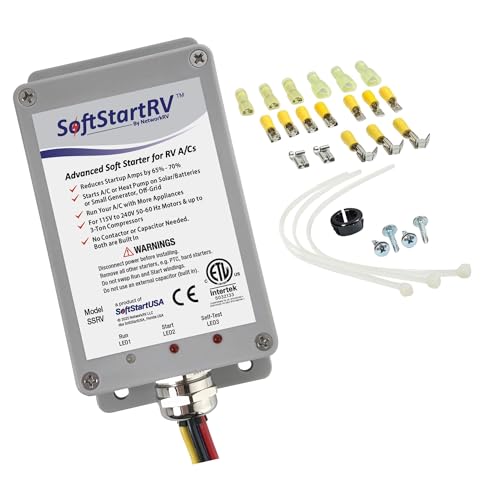
SoftStartRV Soft Start Kit
$295.00A soft starter cuts the compressor inrush, which is what lets a rooftop air conditioner start on a smaller generator or on an inverter.
Best for: Running air conditioning on a 2000W class generator.
Check price on AmazonThe honest case for going solar-only
If your camping style does not involve air conditioning off grid, if you are comfortable running a fan or waiting out a heat spell in shade, and your daily loads are lights, water pump, phone charging, and a 12V or propane fridge, solar alone genuinely covers that without the noise, fuel cost, or maintenance of a generator. This is one comparison where the cheaper, quieter option is the correct one for a real share of RVers, not a compromise.
Fuel type and upkeep, the recurring cost solar avoids
A generator's cost does not stop at the purchase price. Gasoline models need fresh fuel, since stale gas left in the tank and carburetor over long storage periods is a common cause of hard starting, and dual fuel models running on propane avoid that specific problem while adding the cost of propane itself. Either way, an engine-driven generator needs periodic oil changes, air filter checks, and spark plug service the same as any small engine, on a schedule the manufacturer publishes in the owner's manual. Solar has essentially none of this. Once mounted and wired, a panel's only real maintenance is occasionally clearing dust or debris off the surface and checking that roof seals around cable entries have not aged and cracked. That maintenance gap is part of why solar makes sense as the default daily source even in a build that also carries a generator for backup.
Cost and noise scale with hours run, solar does not
The generator side of this comparison gets more expensive the more it is actually used, while the solar side costs the same whether the panels are producing power ten hours a day or sitting idle under cloud cover.
| Usage pattern | Generator | Solar |
|---|---|---|
| Occasional backup, a few hours a month | Low fuel cost, minimal noise complaint risk | Handles nearly all charging on its own |
| Regular evening use, a few hours most days | Fuel cost adds up, noise becomes a real neighbor consideration | Still free to run, but may not fully replace the generator if AC is involved |
| Daily air conditioning off grid | Fuel cost and run hours climb fast, often the dominant recurring expense | Cannot cover this load regardless of array size |
| Extended cloudy or shaded stretch | Becomes the only reliable source until sun returns | Output drops sharply, reserve battery capacity is what bridges the gap |
Convention Source: Directional cost and noise relationships based on how engine-driven generators and solar panels behave under increasing runtime, not a single published dataset..
The case where a generator is the only honest answer
There is one scenario in this comparison where solar is not a reasonable substitute no matter how the array is sized: running a rooftop air conditioner off grid for any meaningful stretch of time. No combination of panels and battery capacity that fits on or in a typical RV changes that math, since the compressor's continuous draw simply outpaces what solar and a practical battery bank can sustain together. Anyone who tells you a big enough solar system removes the need for a generator when air conditioning off grid is part of the plan is skipping over the actual wattage involved. If AC off grid matters to you, budget for a generator as a requirement, not an upgrade.
Generator, solar, and soft-start picks
Solar handles daily charging quietly. A generator is the fallback for cloudy stretches and the only practical way to run air conditioning off grid. A soft starter does not replace either, it just shrinks how large a generator or inverter the air conditioner actually needs.

Renogy 400W Premium Solar Kit with 40A MPPT
$637.99A complete 400W rooftop kit with a matched 40A MPPT controller, the right first purchase for anyone who does not need air conditioning off grid.
Best for: A full roof array bought as one part number.
Check price on Amazon
WEN 56477i 4800W RV-Ready Inverter Generator
$634.99Ships with a TT-30R outlet so a 30A rig plugs in directly, with clean inverter output suited to electronics as well as AC.
Best for: A 30A rig that needs to run one air conditioner off grid.
Check price on Amazon
WEN 6800W Dual Fuel RV-Ready Inverter Generator
$798.00Runs on propane already carried for the furnace, and includes a built-in carbon monoxide shutoff sensor, worth insisting on for any generator run near the rig.
Best for: A large rig or two air conditioners.
Check price on Amazon SoftStartRV Soft Start Kit
$295.00Cuts the compressor's startup inrush so a rooftop air conditioner can start on a smaller generator or on inverter power, without eliminating the need for one or the other.
Best for: Running air conditioning on a 2000W class generator.
Check price on AmazonFrequently asked questions
- Can solar alone run a rooftop air conditioner?
- Not in practice. Even a large solar array cannot keep pace with the continuous draw of a running compressor, and the battery bank backing it up would need to be far larger than what any typical RV can carry to sustain it for a meaningful runtime. Air conditioning off grid realistically requires a generator.
- Is running a generator at a campground allowed?
- Many campgrounds and public land areas restrict generator hours, often prohibiting overnight or early morning use, and some sites ban them outright. Check the specific park's rules before relying on generator power, and consider that restriction when deciding how much to invest in solar as the quieter daily option.
- Do I need both a generator and solar?
- Most full-time boondockers eventually carry both, using solar as the quiet daily charging source and the generator as backup for cloudy stretches or for running air conditioning. Someone who camps briefly, avoids AC off grid, and tolerates cloudy days without power anxiety can reasonably skip the generator.
- Does a soft starter mean I can skip the generator?
- No. A soft starter reduces the compressor's startup surge so the air conditioner can start on a smaller generator or on inverter power that could not otherwise handle the inrush, but it does not eliminate the need for a generator or a very large inverter and battery bank in the first place.
- How much does running a generator cost over a season?
- It depends entirely on fuel price and hours run, but it is a recurring cost every time the generator operates, unlike solar which has no fuel cost after the initial purchase. Someone running a generator daily for air conditioning will spend meaningfully more over a season than someone using it only as occasional backup.
- Where is it actually safe to run a generator?
- Only in open air, well away from windows, vents, and doors, and never inside an enclosed or partly enclosed space like a garage, awning-enclosed area, or beneath the rig. Carbon monoxide is odorless and colorless, and generator exhaust can accumulate to lethal levels even in spaces that feel open.
- Is an inverter generator better than a conventional generator for an RV?
- Yes, for RV use specifically. Inverter generators produce cleaner, more stable power that is safer for sensitive electronics and matches what a converter or inverter/charger expects, while conventional generators can output a less stable waveform. The RV-ready inverter generators referenced on this page are built with that stability, plus the correct 30A outlet, in mind.
Safety note. A generator must never run in an enclosed or partly enclosed space, including under an awning, inside a garage bay, or anywhere near open windows or vents. Carbon monoxide is odorless and kills, and it accumulates faster than most people expect in spaces that look adequately ventilated. Use a generator with a CO shutoff sensor, and keep a working CO detector inside the rig regardless of which generator you run.